
A supplier sends you a Chinese business license. You find the 18-digit code printed near the top — the Unified Social Credit Code. You search it. The company appears in the government system. Registration status: active.
That is a valid data point. It is not a payment decision.
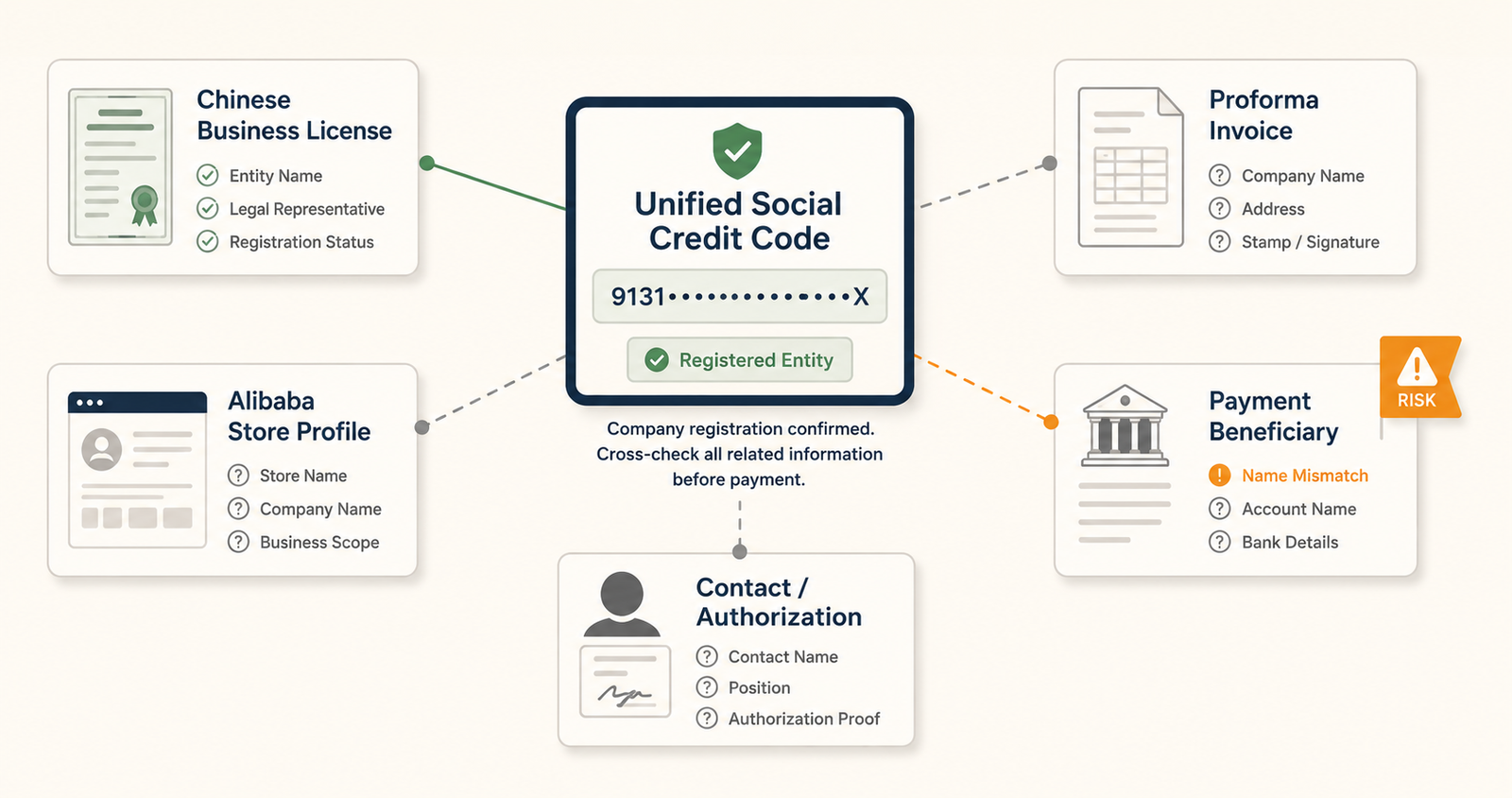
A valid Unified Social Credit Code confirms that a company is registered with Chinese authorities. It does not confirm that the Alibaba store, the proforma invoice, the payment account, and the person contacting you all belong to that same company. Those are four separate verification questions. The code answers none of them on its own.
This analysis draws on 3,123 Reddit comments across r/Alibaba and r/importexport collected between 2018 and 2026, plus documented supplier dispute cases from the same dataset. Where specific cases are relevant, they are cited with source details.
What the Unified Social Credit Code Actually Confirms
The Unified Social Credit Code — sometimes abbreviated USCC — is an 18-character identifier assigned to every legally registered company in China. It functions as a company registration number. When you find it on a business license and search it through China’s official company information system, you can retrieve the following fields:
- Registered company name (in Chinese)
- Registration status (active, suspended, deregistered, or revoked)
- Registered address
- Business scope (the categories of business the company is legally permitted to conduct)
- Establishment date
- Registered capital
- Legal representative
These are registration facts. They reflect what a company filed with Chinese authorities at registration and in subsequent annual reports.
What the code does not produce is a trust score, a transaction history, a quality rating, or any indication of how the company has behaved with foreign buyers. A company registered in 2019 with an active status and a clean record in the government system can still deliver the wrong product, disappear after receiving a deposit, or invoice under a different company name than the one on the license.
If you are still learning where the USCC appears on a Chinese business license and what other fields to read alongside it, see our guide: How to Read a Chinese Business License Without Knowing Chinese.
USCI, USCC, and “Company Registration Number” Refer to the Same Field
Suppliers, freight forwarders, banks, and platform profiles label this field differently. The variation causes failed lookups, not different documents.
- Unified Social Credit Code — the full English translation of 统一社会信用代码, and the wording printed on the business license.
- USCC — the common abbreviation in English-language sourcing documents.
- USCI — Unified Social Credit Identifier. The same code under a different rendering of the final word. It appears on some bank forms and compliance questionnaires.
- Company registration number or business registration number — how the field is often labelled in export paperwork and quotations.
- 18-digit code or 18-character code — a description of the format rather than a name.
All five point to one field on one document. A supplier who sends a “USCI number” and a supplier who sends a “Unified Social Credit Code” have sent the same thing. There is no second identifier to request.
One exception is worth knowing, because it dates the document in front of you. Before the 2015 registration reform, Chinese companies carried a 15-digit registration number (注册号) alongside a separate organization code. The 18-character Unified Social Credit Code replaced both. A supplier who provides a 15-digit number is working from a business license issued under the old system — which means the copy you are holding has not been updated for roughly a decade. Request a current license before running any check against it.
What the 18 Characters Represent — Segment by Segment
The code is not a serial number. Each segment carries registration information, and two of those segments are readable without any Chinese.
| Position | Length | Segment | What it tells you |
|---|---|---|---|
| 1 | 1 character | Registering department | 9 indicates registration with the market regulation authority — the case for ordinary companies |
| 2 | 1 character | Entity category | 1 indicates an enterprise; other values indicate other entity types |
| 3–8 | 6 characters | Administrative division | The county-level district where the entity is registered |
| 9–17 | 9 characters | Entity identifier | The organization code assigned to that specific entity |
| 18 | 1 character | Check character | A calculated value that validates the preceding 17 |
Two practical readings follow from this structure.
The first two characters describe what kind of entity you are dealing with. Most Chinese manufacturers and trading companies carry a code beginning 91 — an enterprise registered with the market regulation authority. A code beginning 92 indicates an individually-owned business (个体工商户), which is not a company and carries a different liability structure. A supplier presenting factory capabilities under a 92 code is describing an operation that is registered as a sole trader. That does not make the supplier fraudulent, but it changes what a dispute would look like, and it is a discrepancy worth raising before a deposit moves.
The character set excludes five letters. The code uses digits and capital letters, but I, O, S, V, and Z are not part of the character set. A character that looks like O in a scanned or photographed license is a zero. A character that looks like I is the digit one. Transcription errors on these two characters are a frequent reason a lookup returns no result — before concluding that a code is fabricated, re-read those positions.
Where the Code Appears on a Chinese Business License
On a standard business license, the Unified Social Credit Code is printed in the upper portion of the document, above or beside the registered company name, and is typically the only 18-character string on the page. It also appears on the license’s QR code data and on official filings issued under the same registration.
The fields printed alongside it — registered name, legal representative, registered capital, business scope, establishment date — are the ones that carry the cross-check value later in this article. Our guide to reading a Chinese business license covers each of those fields and where they sit on the document.
A code copied correctly from a current license is the input for every step that follows. A code copied from an outdated license, or transcribed with a misread character, produces a failed lookup that tells you nothing about the supplier.
How to Check a Unified Social Credit Code
China’s National Enterprise Credit Information Publicity System is one official source for USCC lookups. The interface is primarily in Chinese and may require captcha verification. Browser-based translation tools can help read the results, but the search itself typically requires inputting Chinese characters or the 18-digit code directly.
The process follows this sequence:
- Copy the 18-character code exactly as it appears on the business license. Do not use the supplier’s English trade name or Alibaba store name as the search input — these may not match the registered Chinese company name.
- Search by code. If a result appears, note the Chinese company name displayed in the system.
- Check registration status. Active (存续) means the company is currently registered. Any status indicating suspension, revocation, or deregistration is a hard stop.
- Record the registered address and business scope. These two fields will be relevant in the cross-check steps that follow.
- Screenshot the result page and save it with the date of your search. Registration status can change.
Third-party business information platforms — including Qichacha and Tianyancha — provide USCC lookup functions with English-language interfaces and can help when the official system is difficult to access. Treat them as reading aids. For the pre-payment record you may need in a dispute, prioritize screenshots from the official system or a traceable official source.
One limitation applies to all lookup methods: the result tells you about the registered entity. It does not tell you whether that entity has any relationship to the store, invoice, or bank account your supplier has presented.
What a Clean Search Result Does Not Confirm
This is where most pre-payment verification stops — and where most document-based fraud succeeds.
In the dataset examined for this analysis, supplier verification topics appeared in 927 records, payment and dispute issues in 891 records, and terms like "wire transfer" and "outside Alibaba" combined for 74 appearances. The pattern is consistent: document-level risk often becomes payment-level risk once the buyer sends funds. A supplier whose registration looks clean can still present a payment account that does not belong to the registered company, or an Alibaba store that cannot be traced back to the same legal entity. The USCC lookup closes none of those gaps.
Three specific gaps remain open after every clean result.
The Alibaba store may not belong to that company
Alibaba store names, English trade names, and registered Chinese company names are three different things. They can — and frequently do — differ. A store listed as "Guangzhou Bright Future International Trading" may be operated by a company whose registered name is something entirely different.
The check: compare the Chinese company name returned by your USCC search with the company registration information displayed on the supplier’s Alibaba profile. Alibaba requires suppliers to register with a legal entity. That registered entity name should match your USCC result. If it does not match exactly — or if the Alibaba profile does not display a registered company name — that discrepancy requires an explanation before payment.
The payment account may not belong to that company
A registered company with an active USCC can still request payment to a personal bank account, a third-party account, or an account held by a different legal entity. The USCC search has no visibility into any of this.
This gap matters because payment account mismatch is one of the patterns that appears repeatedly in supplier dispute records. The payment goes to an account that cannot be traced back to the registered company, and the dispute mechanism — whether Trade Assurance or a bank chargeback — faces an immediate evidentiary problem.
The check: request corporate bank account details and compare the beneficiary name on the account with the registered Chinese company name from your USCC search. For higher-value orders, request bank account proof documentation and verify that the account holder name matches exactly.
Your contact person may not be authorized to receive payment
The USCC confirms a legal representative is on file. It does not confirm that the sales contact who has been emailing you is an employee of that company, or that they are authorized to collect payment on the company’s behalf.
This distinction becomes relevant in cases where a supplier account has been compromised, where a middleman is representing themselves as a factory employee, or where payment instructions are sent from a contact whose relationship to the registered company cannot be verified through documents.
The check: for orders above your risk threshold, request communication through the supplier’s verified Alibaba messaging system rather than external email alone. For larger orders, an authorization letter on company letterhead with company stamp (公章) adds a verifiable document layer.
The dispute record in this dataset illustrates how these gaps play out after payment. u/HovercraftPlus4501, posting in r/Alibaba, documented a refund application in which Alibaba’s dispute process did not require the Chinese seller to submit factual evidence to support their position. The issue was not whether the company existed — it did. The issue was that platform verification of company registration did not translate into platform enforcement of document accuracy. A valid USCC, in other words, does not produce a fair dispute outcome automatically. The document trail you build before payment determines what you can prove afterward.
Cross-Check the USCC Against Supplier Documents
The USCC search produces one verified data point: the registered Chinese company name. That name should appear consistently across every document in your pre-payment file. When it does not, you have a question that requires an answer before funds move.
| Cross-Check | Source Document | Compare Against |
|---|---|---|
| Company name | USCC search result | Business license, Alibaba profile, proforma invoice (PI), quotation header |
| Payment beneficiary | Corporate bank account details or bank proof | Registered Chinese company name from USCC |
| Registered address | USCC search result | PI shipping or billing address, supplier profile |
| Business scope | USCC search result | Product category and supplier’s stated capabilities |
| Establishment date | USCC search result | Supplier’s claimed years of experience or operation |
The business scope field is frequently overlooked. A company registered to conduct "import and export of general merchandise" that claims to be a specialized electronics manufacturer is presenting a claim the USCC record does not support. That does not mean the claim is false — some trading companies work closely with manufacturers — but it means the claimed identity requires additional verification before you rely on it.
The establishment date cross-check is similarly low-effort and high-signal. A company registered six months ago that claims fifteen years of export experience has a factual discrepancy in its materials. That discrepancy is worth a direct question.
For a structured walk-through of all pre-payment document checks, the Supplier Verification Checklist covers each step in sequence.
Red Flags — and What to Do When You Find Them
The following conditions, individually or in combination, indicate that the USCC result alone is not sufficient to proceed with payment.
The code cannot be found. Either the code was fabricated, entered incorrectly, or the company registration has lapsed without the supplier disclosing it. Request a current business license and re-run the search before continuing.
The company name in the search result does not match the business license. Business licenses should display the same registered name that appears in the government system. A mismatch between the two documents indicates at minimum an outdated license — and warrants a request for a current, valid copy.
The company name does not match the proforma invoice or quotation. If the PI is issued under a different company name than the one returned by your USCC search, ask the supplier to explain the relationship between the two entities before payment.
The payment account beneficiary is a personal name or a company name different from the USCC result. This is a direct payment risk signal. Suppliers operating through corporate accounts will have a beneficiary name that matches their registered company name. A request to pay a personal account, or an account in a different company’s name, should not be accommodated without a documented explanation.
The supplier’s registration date is recent but their claimed experience is not. A newly registered entity with extensive export claims may be legitimate — companies restructure and re-register. But the gap requires explanation, not assumption.
The supplier declines to provide corporate bank account details. A supplier who cannot or will not share the beneficiary name on their receiving account before payment is removing your ability to run the most basic cross-check. That is a refusal to be verified.
The supplier asks to move payment outside the Alibaba platform. Once payment leaves the platform, Trade Assurance protection ends. A registered company with an active USCC can still request off-platform payment. The USCC does not prevent this, and Alibaba’s dispute mechanism does not cover it. This connects directly to why platform-boundary confusion appeared in 891 payment and dispute records in the dataset examined — and why 26 of those records specifically mentioned payment being directed outside the platform.
In the r/Alibaba post "Some Alibaba ‘factories’ are built to fool foreign buyers," a China-based sourcing professional wrote that "A good-looking website means nothing" and documented seeing suppliers use factory photos that were not theirs. The observation applies directly to USCC checks: a clean registration result tells you the company exists in the government database. It says nothing about whether the factory photos, the product samples, the professional website, or the polished Alibaba profile belong to the entity behind that registration. Visual professionalism is not identity verification. The USCC check and document cross-check are the verification layer.
When one or more of these signals is present, the appropriate response is to pause, request the specific documents that would resolve the discrepancy, and record the supplier’s response. If the supplier cannot or will not provide documents that allow the cross-check to close, that is a pre-payment finding — not a post-payment problem to manage.
If Trade Assurance is part of your payment plan, check its boundaries before relying on it as your fallback: Alibaba Trade Assurance: What It Actually Covers and What It Doesn’t.
For cases where the USCC result is valid but the surrounding documents do not clearly match, a document-based review of the visible risk signals can be requested before payment is made: Supplier Risk Review.
Use the USCC as a Starting Point, Not a Payment Decision
A Unified Social Credit Code search answers one question: is this company registered with Chinese authorities, and what does its registration record show?
It does not answer whether the Alibaba store, the proforma invoice, the payment account, and the contact person all belong to that registered company. Those answers come from document cross-checks — comparing the registered company name against every entity-identifying field in your pre-payment file.
The USCC is where supplier identity verification starts. The cross-check is where it either closes or surfaces a problem that requires resolution before payment.
Related guides:
- How to Read a Chinese Business License Without Knowing Chinese
- How to Verify a Chinese Supplier Before You Pay
- Alibaba Trade Assurance: What It Actually Covers and What It Doesn’t
Still not sure about a supplier?
Download the Supplier Verification Checklist — free PDF covering all pre-payment cross-check steps.
Request a Supplier Risk Review — document-based review of supplier identity, payment account, and pre-payment risk signals.