
A practical guide for small importers, Amazon sellers, and Shopify store owners sourcing from China.
To verify a Chinese supplier before you pay, work through seven checks: get the supplier’s registered Chinese company name; request and read the business license, including the 18-character Unified Social Credit Code; confirm that the company name matches across the license, platform profile, invoice, and payment account; review the supplier’s platform profile and transaction history; verify that the payment account name matches the company name exactly; check the proforma invoice for missing terms; and require product or factory proof before transferring any money. The rest of this guide explains how to run each check and what the warning signs look like.
Why supplier verification matters
Paying a Chinese supplier before checking the registered entity, payment beneficiary, and supporting documents exposes the buyer to risks that become harder to correct after funds move.
This guide is not built on general advice. We analyzed 3,123 Reddit comments across r/Alibaba and r/importexport, posted between 2018 and 2026, where small importers documented what went wrong after they paid. The phrase “trade assurance” appears 758 times in the analyzed record. Across the analyzed sample, 17% of the collected content was classified as explicitly negative. The failure patterns in this guide come from that record, not from a template.
The stakes are concrete. One buyer, posting as u/Electronic-World-858, placed an $11,200 order with a supplier named Taizhou Tbay Technology. The goods shipped with a falsified weight (a 300kg discrepancy) and a customs declaration with no Movement Reference Number. None of the platform-level protections stopped it, and the buyer then pursued a bank chargeback. The case shows the cost of discovering document and shipment inconsistencies only after payment. The checks below focus on the identity, beneficiary, and document gaps that can still be examined before funds move.
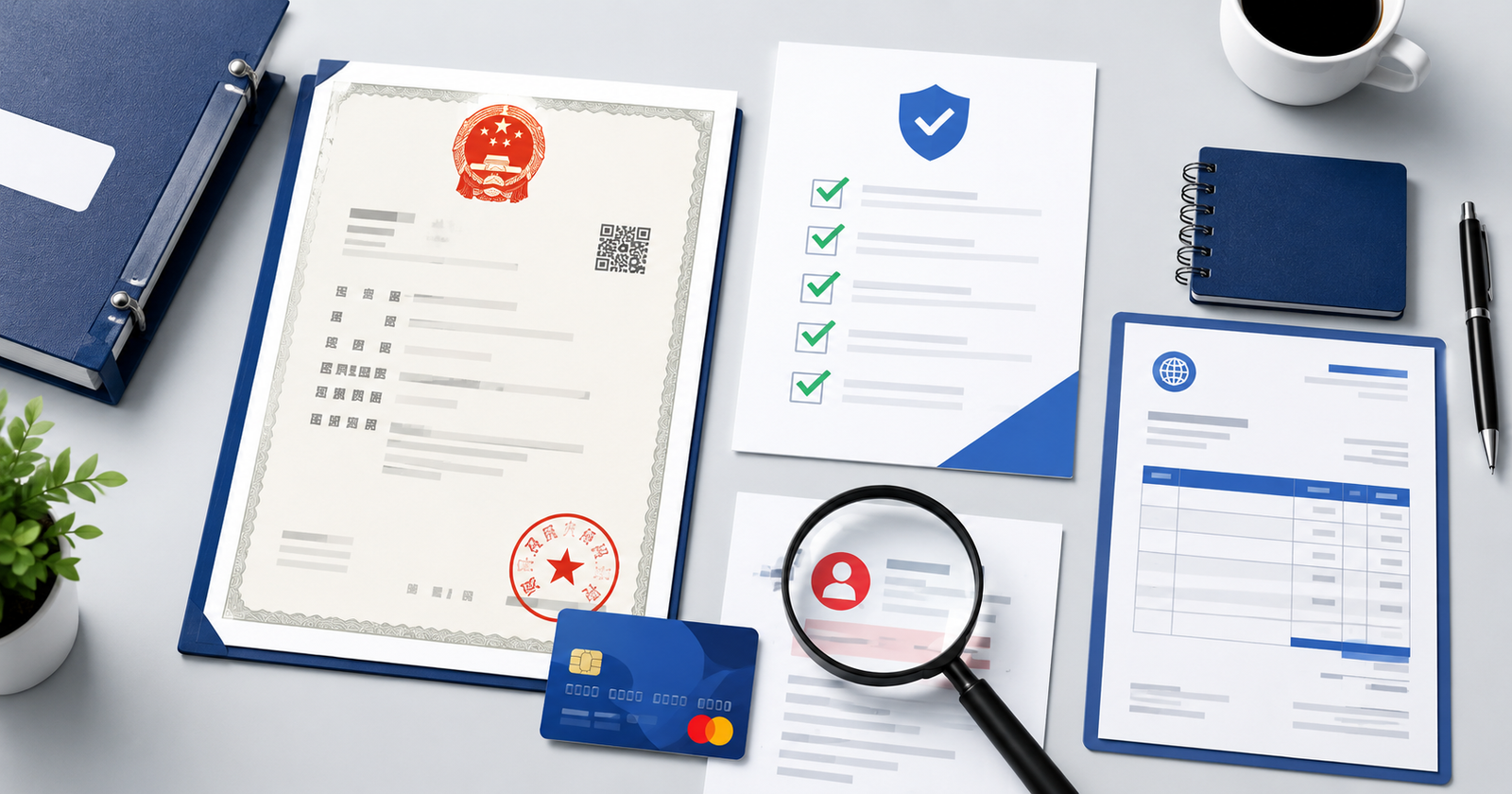
The document gaps become visible when the license, invoice, profile, and beneficiary are compared side by side.
This guide walks you through seven practical steps to verify a Chinese supplier before you transfer any money, whether you are paying for samples, a deposit, or a first production order.
Step 1: Get the supplier’s real Chinese company name
Every registered Chinese business has a Chinese company name. It is the starting point for everything else in this guide.
Ask your supplier directly:
Can you share your company’s full registered Chinese name and business license?
What you are looking for is a name written in Chinese characters, not just an English trade name. Chinese company names follow a consistent format. They usually include the city or province of registration, a brand or industry word, and end with a legal suffix such as Limited Company.
The English trade name a supplier uses on Alibaba can be different from their registered Chinese name, and that is normal. What matters is that both exist, and that you can connect them. If a supplier only gives you an English name and refuses to share any Chinese registration information, treat that as a warning sign.
Step 2: Ask for the business license
The business license is the most important document for checking a Chinese supplier’s registered identity. It is a standard document. A refusal to provide the license leaves the registered identity unverified. Our full walkthrough of the individual fields is in How to Read a Chinese Business License; the summary below covers what to check first.
When you receive it, check these fields:
Company name. The Chinese name on the license should match what the supplier told you. If you later compare this to the payment account and the invoice, all three should be consistent.
Unified Social Credit Code. This is an 18-character identifier used to search and cross-check a Chinese company’s registration record. The code is useful only when it resolves to the same entity named on the license, invoice, and payment instructions. If this field is blank or missing, slow down and ask more questions. For how to read and cross-check the code itself, see the Unified Social Credit Code guide.
Business scope. This tells you what the company is registered to do. If your supplier claims to be a manufacturer but their business scope only lists trading or distribution, they may be operating as a trading company rather than a direct factory. In the same dataset we reviewed, “manufacturer” appears 258 times and “trading company” 136 times, which shows that production identity is a recurring subject in supplier-verification discussions. It is not always a dealbreaker, but it affects how you negotiate and what quality controls you can realistically put in place. The document trail that separates the two is covered in Factory or Trading Company.
Registration date. A company registered less than a year ago that is already handling large export orders deserves more scrutiny, not less.
Registered capital. Very low registered capital on a supplier claiming to be a large manufacturer can be a signal worth questioning.
You can search Chinese company registrations independently using the National Enterprise Credit Information Publicity System at gsxt.gov.cn. However, this system is entirely in Chinese, requires working through a Chinese-language interface, and is often difficult for overseas buyers to use reliably. If you cannot review the license yourself, that is one of the situations where a second opinion can be worth getting before you pay.
Step 3: Check whether names match across all documents
This comparison can expose payment-account and company-name inconsistencies before funds move.
Collect every document where a company name appears and compare them:
- The business license
- The supplier’s Alibaba or 1688 storefront name
- The proforma invoice or quotation they sent you
- The bank account name they ask you to pay
These should all match, or there should be a clear, verifiable explanation for why they differ. A serious risk appears when the payment account name belongs to a different company or an individual, rather than the supplier you have been communicating with.
This mismatch does not always mean the supplier is dishonest. Small Chinese businesses sometimes operate across multiple entities, and personal accounts may appear in smaller transactions. But for a foreign buyer making an international wire transfer, a name mismatch on the payment account is a serious red flag that should be resolved before any money moves. Ask your supplier to explain the discrepancy in writing. If they cannot, or if they become evasive, pause the transaction. Why a personal-account request specifically should stop a payment is covered in Why a Chinese Supplier’s Personal Account Request Should Stop the Payment.
Step 4: Review the supplier’s online profile
If your supplier is listed on Alibaba, check:
- How long they have been on the platform. Newer accounts with aggressive pricing deserve more scrutiny.
- Whether Trade Assurance is available. Trade Assurance can add a layer of platform-based payment protection, but you should still read the order terms carefully and confirm what is covered.
- Verified Supplier or Gold Supplier status. These can be positive platform signals, though they should not replace your own checks.
- Response rate, review history, and transaction volume. A supplier with a long history of completed transactions and consistent reviews is meaningfully different from one with none.
A point worth being precise about: Trade Assurance is an order-protection mechanism. It should not be treated as a substitute for independently checking the contracting entity, beneficiary, and supporting documents. In the cases we reviewed, suppliers with valid Trade Assurance status still asked for final payment before providing shipment evidence that could be independently verified — the Foshan Shunde Deyao Outdoor Metal Products case, reported by u/Fit-Bumblebee1177, is one documented example, where the buyer described the protection as worth nothing once the order went wrong. Platform status is a starting point, not a substitute for the checks in this guide. The boundaries of what the program does and does not cover are set out in Alibaba Trade Assurance: What It Actually Covers and What It Doesn’t.
On 1688, China’s domestic wholesale platform, look for transaction volume and buyer feedback. High transaction volume with consistent reviews suggests an active business. Note that many 1688 suppliers primarily serve domestic Chinese buyers and may have limited experience with export orders, customs documentation, or international shipping requirements. If you are sourcing through 1688, confirm early that they can handle export logistics. Using 1688 to cross-check the same company you found on Alibaba is one of the most effective identity checks available; see How to Use 1688 to Cross-Check an Alibaba Supplier.
Search the supplier’s Chinese company name on Baidu and look for any complaints, dispute records, or negative coverage. This takes a few minutes and occasionally surfaces information that does not appear on trading platforms.
Step 5: Check the payment account carefully
Payment risk is where many buyers lose real money, sometimes even with suppliers they have been communicating with for weeks.
Before transferring anything:
Confirm the bank account name exactly matches the business license. Character-for-character. Not approximately, not close enough.
Be suspicious of any last-minute account change. A message saying the usual account has a problem and asking you to use a different one should stop the process until you verify independently. Call or video-call a known contact at the supplier before sending anything.
Avoid paying to personal accounts, WeChat Pay, or informal payment channels for business orders. These provide limited recourse if something goes wrong. Suppliers handling export orders should usually be able to receive business wire transfers to a corporate bank account.
Be cautious if the supplier only accepts Western Union, cryptocurrency, or similar channels. These are difficult or impossible to recover if the transaction goes wrong.
If the payment account does not match the supplier company name, flag this before paying. This is one of the clearest risk signals a supplier review can identify.
Before continuing, if you want a structured checklist that covers these steps, download the free PDF below. Use it before paying a deposit, ordering samples, or placing a first order.
Step 6: Review the quote or proforma invoice
A professional supplier’s quotation or proforma invoice should be specific enough that there is no room for misunderstanding later. Vague documents create disputes. How to read a PI as a risk document rather than an order form is covered in How to Read a Proforma Invoice Like a Risk Document.
Check that the following are clearly stated:
- Full company name and contact information
- Product name, material, dimensions, and specifications
- Unit price and total order value
- MOQ, which means minimum order quantity
- Payment terms, including deposit percentage, balance timing, and conditions
- Incoterms such as EXW, FOB, or DDP, because these determine who pays for shipping and who carries risk during transit. The difference between an EXW and a DDP price can be significant for a small importer, so confirm which one the quote is based on.
- Production lead time
- Packaging details, including carton dimensions and weight if available
- Whether samples are required before production, and what the sample cost is
Be cautious about quotes that are significantly cheaper than every other supplier you received. A price far below comparable quotes may indicate that a specification, cost, or delivery obligation is missing, either from the quote itself or from what will actually be delivered.
Step 7: Look for product and factory proof
Ask for:
- Factory photos showing the interior, production line, and workers
- Product photos that match your specific requirements, not generic catalogue images
- A sample before committing to a production order
- Any certifications relevant to your product category, such as CE, FDA, REACH, or others depending on your destination market
A video call can be one of the most useful verification tools available. Ask for a live walkthrough of the factory or warehouse over WeChat or WhatsApp if appropriate. A serious supplier should be able to provide some form of reasonable product or facility evidence, even if a live factory tour is not always possible.
Be aware that photos prove less than they appear to. One sourcing professional, posting on r/Alibaba, described suppliers using factory photos that were not even their own. A reverse image search on the pictures a supplier sends takes a few minutes and occasionally exposes this. What factory photos, videos, and profiles actually prove — and what they do not — is examined in Fake Factory Evidence on Alibaba.
Trading companies are not automatically a bad choice. Some manage quality well, offer flexible MOQs, and have strong export experience. But you should know what you are dealing with before you pay, because it affects your expectations, your pricing, and your quality control options.
Common red flags
Watch for these signals across any supplier evaluation. Which of them should stop a payment outright, and which need more evidence first, is worked through in Which Supplier Red Flags Should Stop a Payment.
- Refuses to share a business license
- Payment account name does not match the business license
- Quote is dramatically cheaper than all other suppliers you contacted
- Pushes for full payment upfront before samples or production
- Requests final payment before providing shipment evidence that can be independently verified
- Cannot or will not do a video call
- Last-minute request to change the payment account
- No relevant product certifications for regulated categories
- English-only presence with no Chinese company registration information
- Recently created platform account with no transaction history
- Becomes evasive or defensive when asked basic questions about company information
Any one of these alone may have an innocent explanation. Several together should make you pause.
Questions to ask before paying
Use these directly in your supplier communication before sending any money:
- What is your full registered Chinese company name?
- Can you share a copy of your business license?
- Is the payment account in the same company name as the business license?
- Can we do a short video call so I can see the factory or warehouse?
- What is the sample lead time and sample cost?
- Who handles quality control before shipment?
- What happens if the products do not match the agreed specifications?
- Can you confirm all terms in writing on the proforma invoice?
Frequently asked questions
What is a Unified Social Credit Code?
It is an 18-character identifier used to search and cross-check a Chinese company’s registration record. The code is useful only when it resolves to the same entity named on the license, invoice, and payment instructions. A blank or missing code is a reason to slow down and ask more questions.
Should you pay a Chinese supplier’s personal bank account?
Pause the payment until the relationship between the payee and the contracting entity is explained in writing and can be verified. For a business order, the bank account name should match the company name on the business license. A payment account in an individual’s name, or in a different company’s name, is a serious risk that should be resolved before any money moves.
Does Trade Assurance replace supplier identity verification?
No. Trade Assurance is an order-protection mechanism for defined disputes. Buyers should still independently match the contracting entity, business license, invoice, and payment beneficiary before paying.
What supplier red flags should pause a payment?
A refusal to share a business license, a payment account name that does not match the license, a quote far below comparable offers, pressure for full payment before samples or production, a request for final payment before independently verifiable shipment evidence, refusal of a video call, and a last-minute payment-account change. One alone may have an explanation; several together are a reason to pause.
How can you check a Chinese company registration yourself?
You can search registrations on the National Enterprise Credit Information Publicity System at gsxt.gov.cn. The system is entirely in Chinese and is often hard for overseas buyers to use reliably, so a second opinion can be worth getting if you cannot review it yourself.
What to do if you are not sure
If you have worked through the steps above and something still does not add up, such as a name mismatch you cannot explain, a payment account that does not match, or a quote that is missing too many details, trust that instinct.
Options at this point:
- Request platform-based payment protection on Alibaba when available, and read the coverage terms carefully
- Ask for a third-party pre-shipment inspection before releasing the balance payment
- Get a written explanation from the supplier for anything that seems inconsistent, and keep it on record
- Ask someone with China sourcing experience to review the documents before you pay
If you would rather have a structured second opinion before committing to a payment, that is what the Supplier Risk Review service is for.
Request a Supplier Risk Review -> Submit your supplier details and we will review the key visible risk signals before you pay. This is a risk summary, not a supplier approval or certainty.
Final checklist
Before sending any money to a Chinese supplier, confirm:
- You have their full registered Chinese company name
- You have seen and reviewed their business license
- The company name matches across the business license, platform profile, invoice, and payment account
- You have checked their platform profile and transaction history
- You have reviewed the quote or PI for completeness and missing terms
- You have requested or received a product sample
- You have done a video call or seen reasonable product or facility evidence
- You are not paying full payment upfront for a first order with a new supplier
China Source Lab publishes practical guides, checklists, and tools for small importers sourcing from China. If this guide was useful, the free Supplier Verification Checklist covers these steps in a format you can use during every supplier evaluation.
Start with the free checklist, and if anything looks unclear, request a Supplier Risk Review before you pay.
Still not sure about a supplier?
Use the free Supplier Verification Checklist first. If the company name, payment account, quote, or documents do not match clearly, request a document-based Supplier Risk Review before you pay.