
A supplier sends a business license before payment. It looks official — a government-issued document, dense Chinese text, a registration authority’s seal or an electronic license’s verification code. Most overseas buyers file it away and treat the act of receiving it as the verification itself.
That instinct is what the document cannot support. Across 3,123 Reddit comments analyzed from r/Alibaba and r/importexport (2018–2026), “verified supplier” appears 158 times and “legit” appears 158 times — buyers asking, repeatedly, whether a supplier is real. “Red flag” appears 113 times. The volume of the question suggests the documents buyers already hold are not answering it. A Chinese sourcing professional made the underlying point on r/Alibaba in a thread about how factories present themselves to foreign buyers: a good-looking website means nothing. The same applies to a good-looking license.
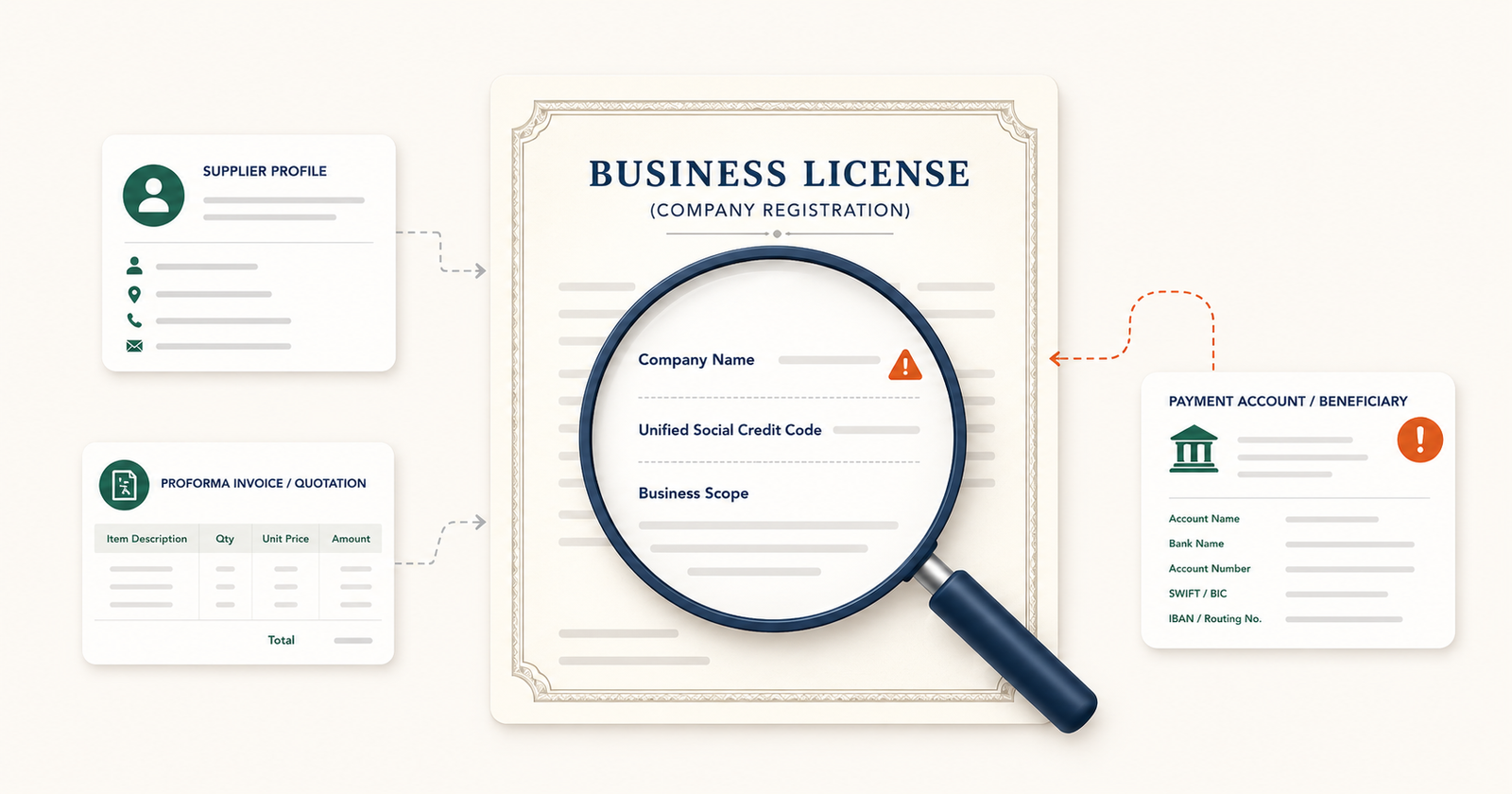
A business license is one of the few supplier documents that can be checked rather than trusted. It carries a registered company name and an 18-digit registration code — two fields that either match the supplier’s other documents or do not. This article covers which fields carry that weight, how to read them without Chinese, and what the license cannot confirm no matter how carefully it is read.
What a Chinese Business License Records — and What It Cannot Confirm
A Chinese business license (营业执照) is the registration document issued to a company by a local market regulation authority. It records the company’s official registration information and nothing beyond it.
The fields it carries: registered company name, Unified Social Credit Code, legal representative, registered capital, date of establishment, registered address, business scope, business status, and issuing authority.
What those fields establish is narrow. They confirm that a legal entity with a specific name exists in a government registry, and they give the buyer a name and a code to compare against everything else the supplier has provided. That is the license’s entire function in a pre-payment review.
What it does not establish is broader than most buyers assume. The license does not confirm that the supplier owns a factory. It does not confirm production capability, quality control, or that the company will ship what it promised. A company can hold a valid license, be registered in good standing, and still be a trading company presenting itself as a manufacturer — a distinction the Reddit record shows buyers struggle with, where “trading company” appears 136 times against 258 mentions of “manufacturer.” The license is one input into that question, covered in Factory or Trading Company? The Document Trail That Exposes the Difference Before You Pay. It is not the answer.
Why the License Must Be Requested Before Payment, Not After
The license is worth requesting before payment for one reason: it supplies the registered Chinese company name, and that name is what every other document gets checked against.
Without it, a buyer is comparing an English trading name — chosen for export marketing, unregistered, changeable — against a payment instruction, a quotation, and a platform profile. Nothing anchors the comparison. With the registered Chinese name and the USCC, the buyer has a fixed reference point.
The comparison runs across the supplier’s Alibaba or 1688 profile, the quotation and proforma invoice, the email signature, and — most consequentially — the beneficiary name on the payment account. Where those resolve to one entity, the identity claim holds. Where they diverge, the buyer has found something before the money moved rather than after.
A supplier’s response to the request is itself information. A readable license provided without friction is the normal case. A blurred image, a heavily cropped scan that removes the USCC, a refusal, or deflection on basic questions about the document are all responses worth slowing down for. “Due diligence” appears 86 times in the analyzed threads, and the pattern in those discussions is consistent: the suppliers who resist basic registration checks are disproportionately the ones the threads were opened about.
A Supplier Verification Checklist covers the license check alongside the payment-account and document cross-checks it feeds into.
Read the Registered Company Name Before Any Other Field
The registered Chinese company name is the first field to read and the most useful one on the document. For pre-payment verification it matters more than the English trading name the supplier uses in every email.
Chinese company names follow a consistent structure:
Region + Brand name + Industry keyword + Company type
Three examples, with the brand element removed:
- 深圳市 [brand] 电子有限公司 — Shenzhen + [brand] + Electronics + Co., Ltd.
- 义乌市 [brand] 贸易有限公司 — Yiwu + [brand] + Trading + Co., Ltd.
- 东莞市 [brand] 塑胶制品有限公司 — Dongguan + [brand] + Plastic Products + Co., Ltd.
The structure means a buyer who reads no Chinese can still extract two things: the registered region, and the industry keyword.
The industry keyword sits in the middle and points to the company’s registered direction. 贸易 (trading) suggests a trading company. 进出口 (import and export) indicates registration for import/export activity. 电子 (electronics), 科技 (technology), 实业 (industrial), and 制品 (products) each point to a registered category — but none of them confirms production capacity. 科技 in particular reads as technical while confirming nothing about whether the company manufactures anything.
These are clues, not conclusions. The signal worth acting on is a mismatch: a company name whose industry keyword has no relationship to the product being quoted, which the supplier cannot explain.
An English trading name that differs from the registered Chinese name is normal and not, by itself, a concern. What matters is whether the supplier can explain the relationship between the two clearly and consistently. A supplier who cannot is describing a company it may not be.
Use the 18-Digit USCC as the Registry Anchor
The Unified Social Credit Code (统一社会信用代码) is an 18-character identifier assigned to each registered company in China. On the license, it functions as the company’s registration ID — the field that connects the document to the official registry.
Four things matter about it at the pre-payment stage. It should match the Chinese company name printed on the same license. It should appear identically across every document the supplier provides. It should be fully visible — a code that is blurred, cropped out of the scan, or obscured is a document that has had its most checkable field removed. And it should resolve to the expected company when checked against the registry.
That last check is the substantive one, and it is covered separately in our guide to the 18-digit Unified Social Credit Code. The relevant point for reading the license is narrower: confirm the code is present, legible, and consistent with the company name beside it. A license whose USCC cannot be read is a license that cannot be verified.
Read Business Scope, Address, and Status as Context, Not Verdicts
Three remaining fields carry weight, provided they are read for what they are.
Business scope (经营范围) describes the activities the company is registered to conduct. It is drafted broadly and in legal language, so it does not read like a product catalog and should not be treated as one. Two situations are worth attention: a scope covering only consulting, advertising, or general services when the order is for manufactured goods; and a scope reading primarily as sales or trading when the supplier claims to be a factory. Neither proves misrepresentation. Both call for supporting evidence — production photos, equipment images, audit reports — that connects the registered company to the product.
Registered address (住所) is the address on file with the registration authority. It is frequently not the factory or warehouse address, and that is normal: a trading company may register at an office, a manufacturer may register in one city and produce in another. The address is useful as a consistency check rather than a location check. What the supplier should be able to do is explain which address is registered, which handles sales, and which produces the goods.
Business status (登记状态) indicates whether the company is in normal registered standing. Suspended, revoked, or cancelled status is not a signal to weigh against others — it is a reason to stop and resolve before any payment.
Date of establishment (成立日期) is worth comparing against the supplier’s claimed history. A company registered recently can employ experienced staff, and a restructuring or renaming can explain a gap. But a two-year-old registration alongside a claim of fifteen years of export experience is a claim that needs its own explanation.
Identify the Ten License Signals That Warrant a Pause Before Payment
None of these confirms fraud. Each is a reason to ask a further question and compare a further document before money moves.
- The supplier declines to provide a business license.
- The image is blurred, heavily cropped, or shows signs of editing.
- The registered Chinese name does not match the payment account or beneficiary name.
- The registered name does not match the platform profile, quotation, or proforma invoice.
- The supplier cannot explain the relationship between its English trading name and its registered Chinese name.
- The business scope has no evident relationship to the product being purchased.
- The company was registered recently but claims many years of industry experience.
- The license appears to belong to a different company than the one quoting.
- The fields on the document are internally inconsistent — the issuing authority does not match the registered region, or the USCC’s embedded region digits contradict the address.
- The registered province or city does not fit the supplier’s account of itself, and the supplier cannot explain the connection.
The pattern across the Reddit record is that these signals rarely appear alone. A supplier whose license raises one question usually raises a second when the payment account is checked — which is why the license review belongs inside a wider pre-payment supplier review rather than standing on its own.
What the License Check Delivers — and Where It Stops
A business license gives a buyer five checkable facts: a registered company name, a USCC, a business scope, a registered address, and an establishment date. Their value is not in the reading. It is in the comparison — against the platform profile, the quotation, the proforma invoice, and the payment account.
Consistency across those documents is a positive signal. It is not proof of safety. A properly registered company with a matching name across every document can still miss a deadline, ship the wrong specification, or fail on quality. The license was never designed to answer those questions.
What the license does is narrower and still worth doing: it converts an identity claim from something asserted into something checkable. A supplier whose documents cannot survive that comparison has told the buyer something specific — before the deposit, rather than after.