
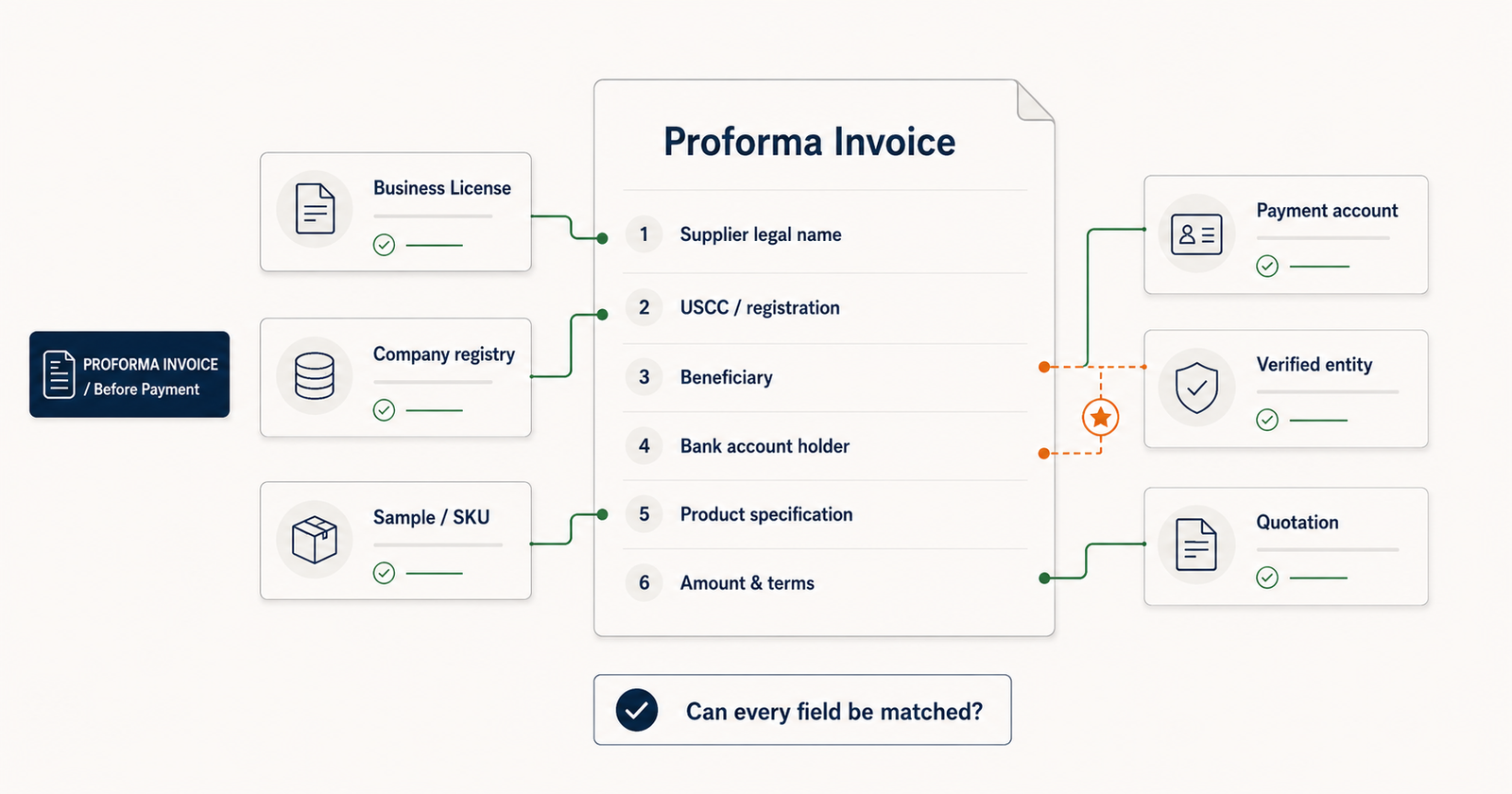
A supplier sends the Proforma Invoice after price negotiation but before payment. That timing is what makes it more than an order form. It is the last document a buyer can compare against everything verified so far — supplier legal name, beneficiary, bank account, product specification, and payment terms — before money moves and the balance of power shifts entirely to the other side.
Most buyers read the PI for two numbers: unit price and total. The fields that actually carry risk sit elsewhere — in the beneficiary line, the bank account holder, the company name that may or may not match the business license, and the payment terms that may have quietly changed since the quote. Analysis of 3,123 Reddit comments across r/Alibaba and r/importexport (2018–2026) found “wire transfer” mentioned 48 times and “outside alibaba” 26 times in supplier dispute discussions — both clustering in threads where a payment instruction, often delivered through or alongside a PI, sent money to the wrong place.
A note on the evidence in this article. The Reddit record rarely labels the problem as “PI manipulation.” Buyers usually describe the outcome: wire transfers, off-platform payment requests, revised beneficiary details, and failed recovery attempts. This article therefore treats the PI as the document where those later disputes first become visible. Where a specific documented case applies, it is named. Where the pattern is inferred from payment-dispute records, it is labeled as a document-risk pattern rather than a confirmed fraud case.
What a Proforma Invoice Is — and What Most Buyers Miss in It
A Proforma Invoice is neither a contract nor a tax invoice. It is the supplier’s statement of what will be shipped, at what price, on what terms, and — most consequentially — to which account the buyer should pay. It arrives at the one moment when the buyer still holds the upper hand: before the deposit.
That is also the moment most verification stops. The buyer has negotiated a price, seen a sample, exchanged dozens of messages, and now treats the PI as a formality to confirm and pay. The document gets scanned for price and quantity, signed, and paid. Every other field — the fields that determine whether the buyer can recover anything if the order goes wrong — passes unchecked.
This matters because the PI is the only document that touches every prior verification step at once. It names the company (which should match the business license). It names a beneficiary (which should match the verified company entity). It specifies a bank account (which should be held by that same entity). It states an amount (which should match the quotation). When u/HovercraftPlus4501 documented their Alibaba dispute, the core finding was that Alibaba’s refund process does not require Chinese sellers to submit factual evidence — but it does require that the buyer’s own paper trail hold together. Where that protection starts and stops is covered in Alibaba Trade Assurance: What It Actually Covers and What It Doesn’t. A PI whose fields do not cross-check is a paper trail with a hole in it.
The Six Fields That Must Cross-Check Against Other Documents
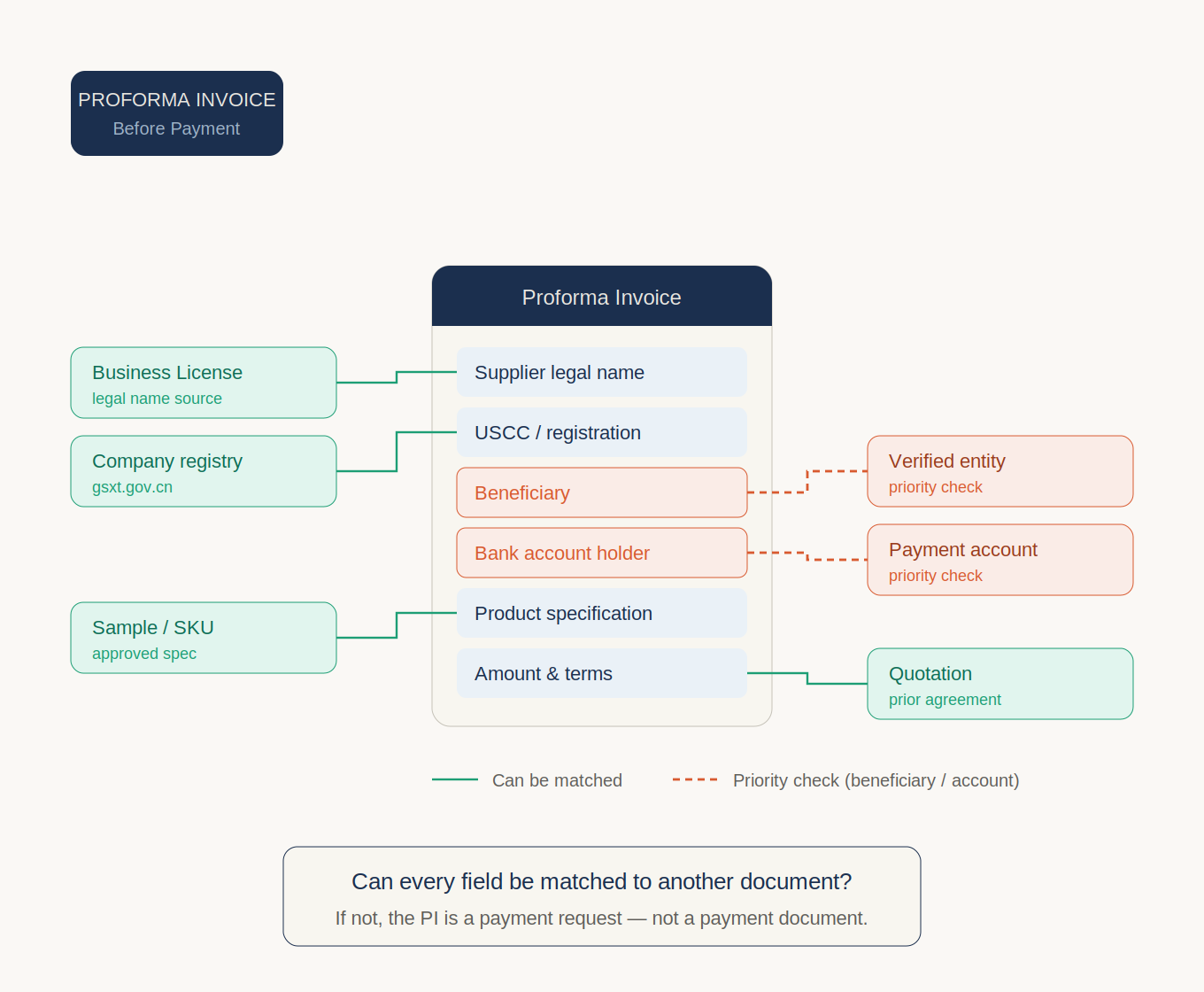
Reading a PI as a risk document means checking each field against a second source. A field that cannot be matched to another document is not verified — it is asserted.
1. Supplier legal name ↔ business license The company name on the PI must match the registered name on the business license, in both Chinese characters and English transliteration. Transliteration differences are normal; a different entity is not. The method for reading the license is covered in How to Read a Chinese Business License Without Knowing Chinese.
2. USCC / registration ID ↔ gsxt.gov.cn The PI itself rarely prints the 18-digit Unified Social Credit Code — that field lives on the business license. Take the USCC from the license, run it at gsxt.gov.cn, and confirm the registered company name there matches the company named on the PI. A USCC that resolves to a different company, or to no company, is a stop signal.
3. Beneficiary name ↔ verified company name The beneficiary is who the money is paid to. On a clean PI, the beneficiary is the same legal entity as the supplier. When it is not — when the beneficiary is a personal name or an unrelated company — the document is structured to break the link between who you vetted and who you paid. This is the single field most worth checking, and the reasoning behind it is in Why a Chinese Supplier’s Personal Account Request Should Stop the Payment.
4. Bank account holder ↔ beneficiary entity The beneficiary name and the bank account holder are not always the same field on a PI, and overseas buyers often read them as interchangeable. They are not. The account holder is the name registered with the receiving bank. A PI can list the correct company as beneficiary while the bank line routes funds to a personal account or a different company. Both lines must name the same verified entity.
5. Product specification ↔ sample / confirmed SKU The specification on the PI must match the sample the buyer approved — material, dimensions, model number, quantity per carton. A PI that drops to a vaguer line than the approved sample — listing only a product name with no grade, or “packing: export standard” instead of the agreed carton spec — removes the buyer’s ability to reject goods on spec grounds later.
6. Amount and payment terms ↔ quotation / prior agreement The total, the deposit ratio, and the payment schedule on the PI must match what was quoted. A PI total higher than the quote, or a deposit ratio larger than agreed, is a change the buyer needs explained in writing before paying.
A Supplier Verification Checklist walks through these cross-checks as a single sequence, which is useful when a PI arrives with a payment deadline attached.
Price Signals Hidden Inside the PI
Beyond identity, the numbers on a PI carry their own signals. None of these is proof of fraud on its own. Each changes the buyer’s exposure when supplier identity and payment account have not been independently verified.
A final PI price that differs from the negotiated quote — usually higher — is the easiest signal to miss. The difference may be legitimate (a freight line added, a currency adjustment) or it may be a quiet markup the buyer is expected not to notice.
A deposit ratio that jumps at the PI stage is the second. A high deposit is not automatically wrong. But a supplier who quoted 30% and then issues a PI demanding 70% before production has shifted the buyer’s exposure substantially, and the timing — after negotiation, under deadline — is worth questioning.
A “discount if you wire today” line is the third. Urgency applied to the payment method, rather than the product, is a pattern that recurs in dispute threads. The wire-transfer and off-platform mentions in the Reddit record — 48 and 26 respectively — often appear in the same type of payment-pressure discussion: move money fast, and move it outside the platform.
A mismatch between the bank’s location, the invoice currency, and the company’s registered entity is the fourth — though this one needs care. An offshore account, often in Hong Kong, is routine for Guangdong suppliers and is not a signal by itself. What matters is whether the account relationship can be explained: a supplier whose beneficiary bank, account holder, and registered company tell three unrelated stories warrants an explanation before payment, not after.
Identify the Three Ways a PI Gets Changed After Confirmation
The highest-risk PI is not the first one. It is the revised one. Once a buyer has agreed in principle, a second PI arrives with one or more fields changed — and because the buyer has already mentally committed, the changes get less scrutiny, not more. Three patterns recur.
Pattern 1: The beneficiary or bank account changes
What changes: The first PI names the company account. A revised PI, often sent close to the payment deadline, lists a different beneficiary or a new bank account, framed as “updated banking details” or “our accountant sent the correct account.”
Why it matters: This is the change most directly tied to loss of payment traceability. A wire to a changed beneficiary leaves the verified company chain entirely.
Cross-check before payment: Pull the original PI and compare the beneficiary and account lines character by character. Any change to either requires written clarification on company letterhead matching the business license before the wire goes out.
Pattern 2: The amount or a fee changes
What changes: The revised PI total is higher than the quote, or a new line appears — “handling fee,” “bank charge,” “inspection fee” — that was never discussed.
Why it matters: Small additions are easy to absorb under deadline pressure and hard to dispute after payment.
Cross-check before payment: Compare the PI total and every line against the quotation. Require a written reason for any addition.
Pattern 3: The lead time or payment terms change
What changes: The deposit ratio rises, the balance-payment trigger shifts, or the production timeline lengthens without explanation.
Why it matters: Terms that move in the supplier’s favor at the PI stage are terms the buyer agreed to under different assumptions.
Cross-check before payment: Match the terms on the PI to the prior agreement. Treat any unexplained shift as a point to resolve before paying, not after.
Before You Pay: A Proforma Invoice Verification Sequence
This sequence runs against the final PI before any deposit moves. It assumes the buyer has already reviewed the business license and the payment account; the PI is where those checks converge.
Step 1. Save the first PI version received. Every later version is checked against it.
Step 2. Compare the supplier legal name on the PI to the business license — Chinese characters and English both.
Step 3. Take the USCC from the business license, run it at gsxt.gov.cn, and confirm the registered company name matches the PI.
Step 4. Confirm the beneficiary name is the verified company entity, not a personal name or an unrelated company.
Step 5. Confirm the bank account holder is the same entity as the beneficiary.
Step 6. Compare the PI total and deposit ratio to the quotation.
Step 7. Compare the product specification to the approved sample or confirmed SKU.
Step 8. Reject any revised PI that changes the beneficiary, the bank account, or the amount without a written explanation and supporting documents.
For buyers running this alongside a wider pre-payment review, the full document cross-check sits inside How to Verify a Chinese Supplier Before You Pay.
What a Verifiable Proforma Invoice Should Contain Before Payment
The verification sequence above tells the buyer what to check. The final question is whether the PI can stand as a payment document at all.
A PI is not safe because it looks professional. A clean letterhead, a company chop, and a tidy table prove nothing about where the money goes. The document is usable only when each field can be matched to another source.
A verifiable PI contains the same legal company name as the business license; the same USCC or registration identity where one is provided; a beneficiary name that matches the verified company entity; a bank account held by that same entity; a clear product specification that matches the approved sample; a quotation amount consistent with the final total; payment terms consistent with the prior agreement; no last-minute beneficiary or account change; and no payment instruction delivered informally outside the PI itself.
Against that list, the test is simple. If the PI cannot be verified field by field, the buyer does not have a payment document. The buyer has a payment request — and in the Reddit record, that is where many recoverability problems begin.