
When u/Electronic-World-858 placed an $11,200 order with Taizhou Tbay Technology, the transaction ran through Alibaba Trade Assurance. That one decision — keeping payment on-platform — gave the buyer at least a theoretical dispute path when the supplier shipped goods with a 300kg weight discrepancy and an illegal customs declaration with no MRN. The buyer ultimately had to pursue a bank chargeback, but the paper trail existed.
Now consider what happens when a supplier asks you to skip the platform and wire money to a personal account instead. For that off-platform wire, there is no Alibaba dispute path, no platform transaction ID, and no payment record Alibaba can use as evidence. The protection structure that exists for a platform payment does not extend to a wire that leaves the verified company chain.
This is not a rare edge case. Analysis of 3,123 Reddit comments across r/Alibaba and r/importexport (2018–2026) found “wire transfer” appearing 48 times and “outside alibaba” 26 times in supplier dispute discussions. “Chargeback” appeared 103 times and “credit card” 175 times — a pattern consistent with buyers trying to recover money after payment-channel problems.
What “Personal Account” Actually Means — and Why Suppliers Ask for It
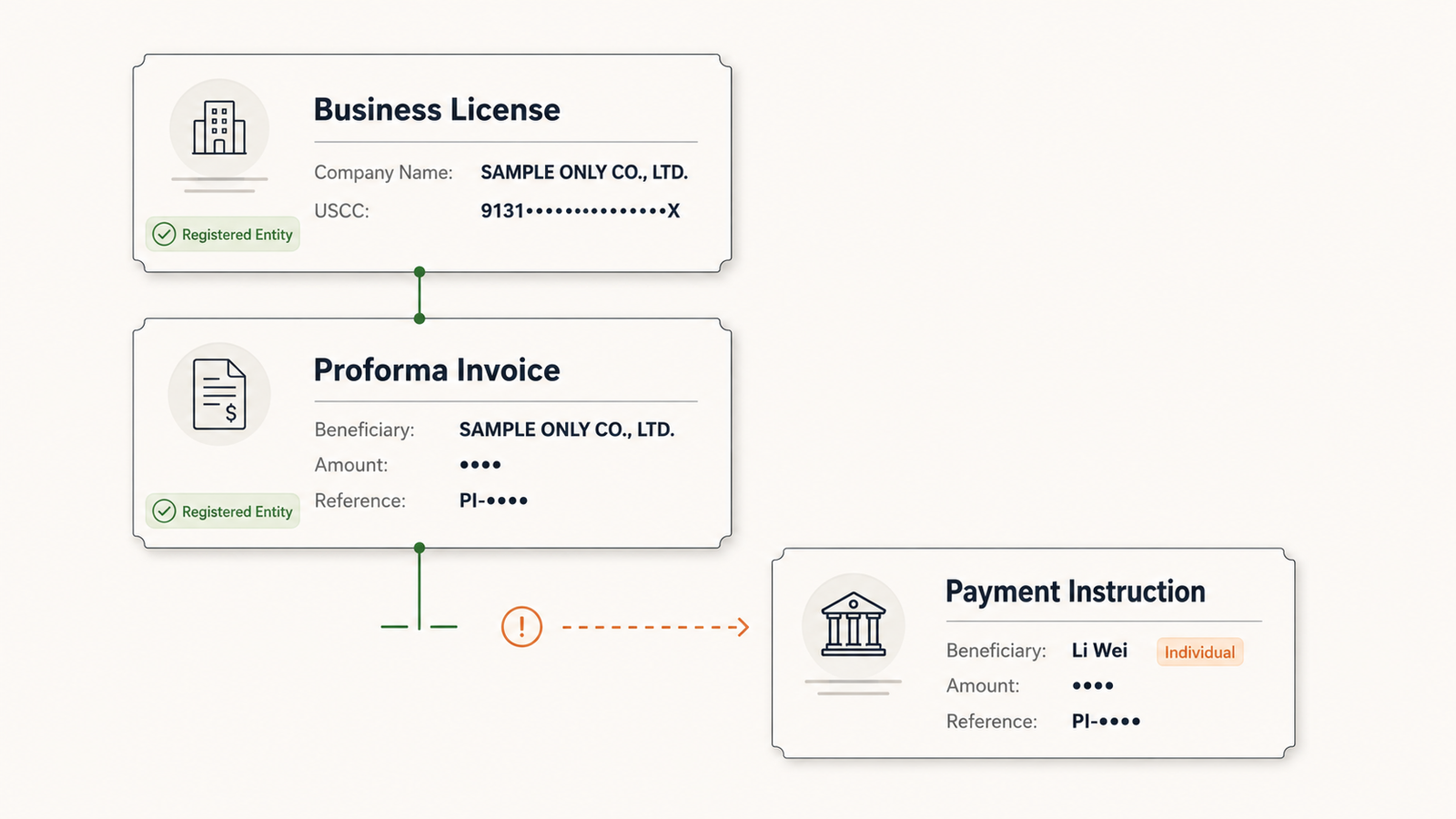
A personal account payment request means the beneficiary on the wire transfer or payment instruction is an individual — not the registered legal entity that signed your Proforma Invoice or appears on the business license.
Suppliers offer three explanations for this. The first is convenience: “Our company account has a slow processing time.” The second is cost: “We save on bank fees if you send to my personal account.” The third is the most concerning and the most common in dispute threads: no explanation at all. The account number simply appears in a revised PI or in a WeChat message, presented as standard procedure.
None of these explanations change the risk structure. When you pay a personal account, the money leaves your bank and enters a privately held account with no contractual link to the supplier entity you vetted, the business license you reviewed, or the Trade Assurance order you created. The legal relationship you constructed with your due diligence doesn’t follow the money.
In the 26 Reddit discussions specifically referencing payment “outside Alibaba,” a recurring pattern appears: the supplier moves the conversation to WeChat, WhatsApp, or email; the revised payment instruction appears as a casual message rather than an official document; and buyers who question it are reassured with phrases like “this is normal for Chinese suppliers” or “our Alibaba account is under review.”
The Three Documents That Must Match Before You Wire
Before any payment leaves your account, three documents must name the same legal entity as beneficiary:
1. The business license (营业执照) The registered company name in Chinese characters and its English transliteration. If you have reviewed the business license using the cross-check method described in How to Read a Chinese Business License Without Knowing Chinese, you have this name on file.
2. The Proforma Invoice (PI) The “Beneficiary” or “Payee” field must match the business license name exactly. Transliteration differences are common — “Shenzhen Tbay Technology Co., Ltd.” and “深圳塔贝科技有限公司” refer to the same entity — but the underlying Unified Social Credit Code must resolve to the same registration. Instructions for cross-checking USCC against gsxt.gov.cn are covered in Unified Social Credit Code: How to Verify a Chinese Company Is Real.
3. The bank wire instruction or payment account The account holder name on the beneficiary bank record must match the above. A personal account will not. An account registered to a different company — a parent entity, a related trading company, a holding structure — also will not, and warrants the same level of scrutiny.
When these three documents name different entities, the discrepancy is not a paperwork error. It is the single most reliable pre-payment signal that the transaction is structured to prevent recovery. If the supplier explains the mismatch as a factory-versus-trading-company arrangement, verify whether the entities are actually connected; the same document logic applies whether you are dealing with a factory, trading company, or related payment entity.
A Supplier Verification Checklist covers all three document cross-checks in a single workflow — useful when payment instructions arrive under time pressure from a supplier.
Why Trade Assurance Does Not Protect Off-Platform Payments
Alibaba’s own Trade Assurance flow requires the buyer to pay through Alibaba.com. Its Help Center states that payment cannot be protected if it was made outside the platform. That is the boundary suppliers exploit when they ask for a personal account wire after the buyer has already discussed a Trade Assurance order.
This is not an obscure policy footnote. The Alibaba dispute interface requires a transaction ID linked to a platform payment. A wire transfer to a personal account produces no such ID. When u/HovercraftPlus4501 documented their dispute with Alibaba, the core finding was that Alibaba’s refund process does not require Chinese sellers to submit factual evidence — but it does require that the original transaction occurred on the platform. Without that foundation, dispute submissions are rejected at intake.
The practical consequence: a buyer who transfers $8,000 to a personal account after creating an $8,000 Trade Assurance order has not protected $8,000. They have protected nothing, because the payment that actually moved was never captured by the protection system. This gap is the exact mechanism that off-platform payment requests are designed to exploit.
Identify the Four Document Patterns That Precede a Personal Account Request
Based on the Reddit dispute record, off-platform payment requests follow recognizable document patterns. Buyers who catch these patterns before wiring have the opportunity to stop. Buyers who miss them typically reconstruct the sequence after the fact, in dispute threads.
Pattern 1: The revised PI with a new beneficiary The supplier sends a first PI with company details. After order confirmation — sometimes hours before the payment deadline — a revised PI arrives with a different beneficiary name or a new bank account. The revision is framed as “updated banking details” or “our accountant sent the correct account.”
Cross-check: Pull the original PI. Compare beneficiary names character by character. If the registered company name changed, stop and request written clarification on company letterhead before proceeding.
Pattern 2: Payment instructions delivered outside official documents The account number arrives via WeChat, WhatsApp, or email — not embedded in a signed PI or contract addendum. No document header, no company stamp, no formal structure.
Cross-check: Refuse to process any payment instruction not delivered on signed company letterhead matching the business license. This is a reasonable request even for small orders and a non-negotiable control for any order large enough to hurt your business if it fails.
Pattern 3: Beneficiary name contains a personal name rather than a company name
Chinese company names usually contain corporate identifiers such as 有限公司, 股份有限公司, 集团, or a registered industry descriptor. A beneficiary field containing only a personal name — two to four Chinese characters, a pinyin name, or an individual English name — is not a company account.
This is not a document to investigate further as if it were a normal discrepancy. It is a stop condition. Do not wire the funds. Require the supplier to either reissue the payment instruction under the verified company account or provide the receiving entity’s business license, Unified Social Credit Code, and written authorization from the supplier named on the PI. A verbal explanation that “this is our boss’s account” or “this is our accountant’s account” should not move the transaction forward.
Pattern 4: Account registered to a company that does not match the USCC The beneficiary is a company name — but not the company on the business license. This is a more sophisticated variant. The receiving entity may be a related trading company, a payment intermediary, or a shell structure.
Cross-check: Request the USCC of the receiving entity and verify it at gsxt.gov.cn. A legitimate supplier using a related payment entity can produce this in minutes. Refusal or delay is a stop signal.
Before You Wire: A Pre-Payment Account Verification Sequence
Why the Payment Channel Must Be Checked Before the Wire
The payment record does not support a clean recovery-rate table. It does show a clear hierarchy of recourse. Credit card payments through a platform leave a chargeback path. PayPal leaves a limited buyer-protection path. Company-account wire transfers leave only a narrow bank-recall path. Personal-account wire transfers leave the weakest public recovery record: in the reviewed Reddit material, we did not identify a clear case where a buyer recovered funds after wiring to a personal account.
The frequency data supports this hierarchy. “Credit card” appears 175 times in the dataset and “chargeback” 103 times — the two terms cluster in threads where buyers describe partial or full recovery. “Wire transfer” appears 48 times and “outside alibaba” 26 times — these cluster in threads where buyers describe being unable to recover. That does not prove personal-account wires are unrecoverable. It shows the public dispute record offers almost no practical recovery path once the payment leaves the verified company chain.
The verification sequence below takes approximately 20 minutes for a standard transaction. It is the minimum standard before any wire transfer to a Chinese supplier.
Step 1. Locate the beneficiary name on the final PI. Confirm it exactly matches the company name on the business license.
Step 2. Locate the 18-digit Unified Social Credit Code on the business license. Run it at gsxt.gov.cn. Confirm the registered company name matches the PI beneficiary name.
Step 3. Confirm the payment account holder name matches the USCC-verified company name. If the supplier uses a third-party payment processor, request the processor’s business license and USCC and run the same check.
Step 4. If the payment instruction arrived through WeChat, email, or any channel other than a signed PI, request reissuance on signed company letterhead before proceeding.
Step 5. If any document in the chain names a personal account holder, stop the transaction. Request a safer payment alternative — a platform-paid Trade Assurance order, PayPal Goods and Services where available, or a letter of credit through your bank. If the supplier refuses all alternatives, treat refusal as a stop signal.
For buyers conducting pre-shipment verification at the same time, the full document cross-check is covered in How to Verify a Chinese Supplier Before You Pay. If you need a restrained document-based review before wiring, China Source Lab also offers a Supplier Check for business license, PI, and payment-account consistency.
What Happens After You’ve Already Paid a Personal Account
If the wire has already gone through, the recovery window is narrow and the options are limited. This section does not minimize that. It documents what the Reddit record shows as available paths, in order of feasibility.
Bank recall (within 24–72 hours of transfer): Contact your bank immediately and request a wire recall. The recall window is short. Success depends on whether the receiving bank has already processed the credit. Recoveries in the public Reddit record are rare even within the first 24 hours, but the window closes fast — every hour matters.
Credit card chargeback (if the payment was on card): If any portion of the payment ran through a card — including a card linked to a PayPal or Trade Assurance transaction — initiate a chargeback. Document the discrepancy between the promised goods and the actual delivery, or the non-delivery. Card chargeback rules vary by issuer. Evidence of payment to a personal account when a company was the contracted party strengthens the claim.
Alibaba dispute (only if a platform order exists): If a Trade Assurance order exists and any portion of the payment ran through the platform, file a dispute immediately. As documented in the Taizhou Tbay Technology case, dispute outcomes are uncertain — but the process requires that a platform payment record exists. An off-platform payment with no platform order cannot be escalated at all.
Legal action: Civil claims in Chinese courts or arbitration through a contractual clause are technically possible, but for small importers this path typically requires Chinese counsel, entity identification, translated evidence, and a claim value high enough to justify the cost. For most small orders, it is a last-resort path rather than a recovery plan.
The consistent finding across the dispute record: the earlier the intervention, the higher the chance of partial recovery. Waiting to see if the supplier responds to messages after a personal account transfer adds days without adding options.