
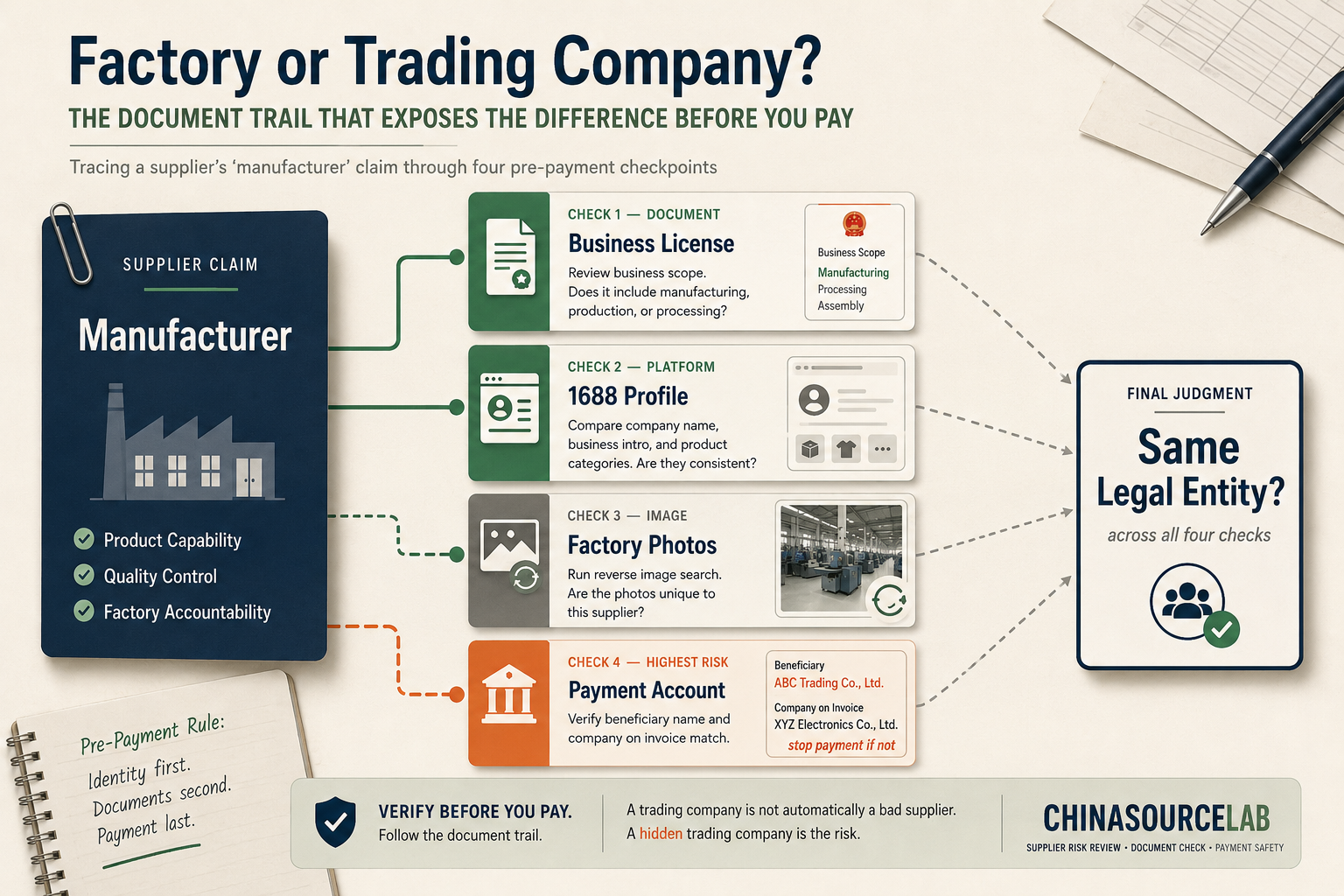
The supplier’s Alibaba page says "manufacturer." So does the one next to it, and the one after that. On many supplier pages, "manufacturer" functions more like a profile claim than a verified production fact. Even where a platform badge or third-party assessment exists, it does not prove that the entity receiving the payment owns the factory producing the order.
In an analysis of 3,123 Reddit comments across r/Alibaba and r/importexport between 2018 and 2026, the word "manufacturer" appeared 258 times — and "trading company" appeared 136 times, often in the same threads. The pattern is not buyers debating which type is better. It is buyers who have already paid, now discovering that the supplier they treated as a factory was, in fact, a middleman. The distinction surfaces at the worst possible moment: after the deposit clears, when specifications need to change, or when a quality dispute requires factory-level accountability.
A trading company is not automatically a bad supplier. A hidden trading company is the risk.
This analysis is based on 3,123 Reddit comments from r/Alibaba and r/importexport reviewed in May 2026, including 258 mentions of "manufacturer," 136 mentions of "trading company," and 106 mentions of "1688" in supplier verification threads. It also draws on documented sourcing-professional warnings about fabricated factory photos and misleading supplier presentation on Alibaba. Where a single case is documented, it is cited as such. Where the evidence is behavioral, it is treated as a risk signal — not as proof of fraud.
Why a Hidden Trading Company Changes the Risk Before Payment
When a buyer believes they are dealing with a factory, they make a specific set of assumptions: that the supplier controls production, that specifications can be adjusted at the source, that a quality problem can be escalated to the people running the machines. Those assumptions shape the price negotiation, the inspection plan, and the payment terms.
All of those assumptions are wrong if the supplier is a trading company that has not disclosed it.
The structural differences are not abstract. A factory can answer questions about raw material sourcing, production lead time, and defect rate from its own data. A trading company has to ask its actual factory — and then relay the answer, filtered through its own commercial interest. A factory can accommodate a third-party inspector in its production facility. A trading company can attempt to arrange it, but the actual factory may decline, delay, or present a different facility. When the buyer contracts directly with the factory entity, that entity is the accountable counterparty if something goes wrong. When the contract is with a trading company, accountability stops there — the trading company will often point to "the factory" as the source of the problem, but that is a party the buyer has never contracted with and cannot hold accountable.
The payment risk is this: buyers who price, inspect, and pay as if they are dealing with a factory, but are actually dealing with a trading company, have built their entire risk model on a false premise.
Check the Business Scope for Manufacturing, Processing, or Sales-Only Language
The business scope field on a Chinese business license is the first document-level signal. It is not conclusive on its own, but it is the fastest way to identify a structural mismatch between what a supplier claims and what it is legally registered to do.
Factories — entities with actual production operations — typically register business scope language that includes terms like: 生产 (production), 制造 (manufacturing), 加工 (processing), 组装 (assembly). These words indicate that the registered entity is authorized to manufacture, not merely to sell.
Trading companies register differently. Their business scope typically centers on: 销售 (sales), 批发 (wholesale), 进出口 (import and export), 贸易 (trading), 代理 (agency). These terms describe commercial activity, not manufacturing.
The mismatch to watch for: a supplier who presents as a factory but whose business license scope lists only sales and trading language. That discrepancy is not proof of deception — some legitimate factory-affiliated entities handle exports through a separate trading arm — but it requires explanation before payment.
A broader warning applies here. A business scope that lists both manufacturing and trading language, covering an unusually wide range of product categories, should not be read as a stronger credential. A single entity claiming to manufacture electronics, furniture, textiles, and machinery is describing the scope of a trading company, not a specialized factory. As one sourcing professional posted on r/Alibaba: "A good-looking website means nothing." The same applies to a business license that has been written to look like everything.
Before payment, the business scope field should be read against what the supplier is actually selling. If the product category is not reflected in the manufacturing language of the license, ask for an explanation in writing.
If the business scope, USCC record, and supplier profile do not point to the same entity, cross-check the company’s USCC before treating the supplier as unresolved before payment. The broader document sequence is covered in the Supplier Verification Checklist.
Cross-Check the Business License Against the 1688 Profile
The business license tells you what the entity is registered to do. The 1688 profile gives you another version of how the same entity presents itself — and that version can be compared against the business license and Alibaba profile.
1688.com is China’s domestic wholesale platform, operated by Alibaba Group. Suppliers who sell on both Alibaba (international) and 1688 (domestic) maintain separate profiles for separate audiences. The gap between those two profiles is the diagnostic tool — not because every 1688 profile is reliable, but because the supplier is presenting itself to a domestic wholesale audience that already knows what a real factory profile looks like.
In the analysis of r/Alibaba discussions, 1688 was referenced 106 times in supplier verification threads. A Shenzhen-based sourcing professional, in a post that received 53 upvotes and 52 comments, described using 1688 as a standard cross-check step when evaluating suppliers for international clients.
The cross-check works as follows. Take the Chinese company name from the business license — this is the field labeled 名称. Search that name on 1688.com. If the supplier appears, examine five things:
Company name match. The 1688 entity name should match the business license name exactly. A different company name — even a similar one — is a flag requiring explanation.
Product category concentration. A factory specializes. If the 1688 storefront sells products across multiple unrelated categories — industrial hardware, consumer electronics, and promotional merchandise in the same store — that is the profile of a trading company sourcing from multiple factories, not a manufacturer with a core product line.
Production language in the company introduction. Factory profiles on 1688 typically describe equipment, capacity, headcount, and production process. Trading company profiles describe sourcing relationships, product range, and delivery capability. The absence of any production language in the company introduction, for a supplier claiming to be a manufacturer, is a structural inconsistency.
Registered address match. The address on the 1688 profile should correspond to the address on the business license. A significant geographic discrepancy — especially if the 1688 address is in a commercial district while the license address is in an industrial zone, or vice versa — warrants follow-up.
Price range against Alibaba listing. This comparison is useful but not clean. Currency conversion, export tax rebates, freight assumptions, and platform fee structures all sit between the two prices, so direct subtraction does not produce a meaningful number. What is more reliable than the raw numbers: whether the 1688 price for the same product is in a plausible range given the product category. A trading company pays factory price plus margin; its 1688 domestic price will usually sit above factory-direct cost. If an Alibaba supplier’s export quote is substantially lower than its own 1688 domestic listing for the same item, after accounting for export tax rebates and platform costs, that gap requires an explanation. It may have one. The point is to ask before paying.
Four Communication Signals That Point to a Middleman
Document cross-checks establish identity. Communication patterns reveal the operational reality.
A factory representative should be closer to production information. A trading company representative is usually one step removed. That structural difference produces specific, observable patterns in how communication unfolds — patterns that appear before any document is requested.
"I will check with the factory." A factory sales representative can answer basic production questions from their own data: current lead time, available configurations, the raw material spec for what is on the line right now. When a supplier consistently responds to these questions with "let me check" or "I need to ask the factory" — and the follow-up takes a day or more — the supplier is relaying questions to a third party. This signal alone is not conclusive; some factories have internal communication bottlenecks, and not every sales representative is technical. But when it appears alongside the document signals above, it confirms the picture.
Sample lead times that do not match claimed production capacity. This one is harder to explain away, but it requires the right framing. Sample timing varies by product category — molded parts, certified electronics, and custom textiles all carry tooling and approval cycles that a catalog item does not. The signal is not the number of days; it is whether the supplier can explain the timing in relation to its own production schedule, inventory, or tooling status. For standard catalog items that the supplier claims to manufacture in-house, a vague three-to-four-week sample timeline with no production-logic explanation is worth probing. One possible explanation is that the sample is being sourced from a separate factory, then repacked or relabeled before shipment. Ask for the reason in writing.
MOQ logic that does not hold together. A factory’s minimum order quantity reflects its production economics — setup cost, batch size, quality control parameters. The number is internally consistent within a product line. When a supplier quotes wildly different MOQs across unrelated product types with no explanation tied to production logic, it is working against multiple factories’ constraints, not its own.
Payment account entity mismatch. This is not a communication signal in the ordinary sense. It is the hardest stop condition on this list. When the bank account name, the Trade Assurance holder, or the invoice entity does not match the business license name, money is being directed to a different legal party than the one the buyer believes they are contracting with. Do not ask the supplier to explain it verbally. Do not accept a reassurance that "it is our related company." Stop the payment and require written documentation from both entities before proceeding. This issue is examined separately in the context of payment account verification; it appears here because it typically surfaces in the final exchange before transfer.
Run the Reverse Image Search Test Before You Trust Factory Photos
Factory photography is cheap to acquire and carries no legal identity verification requirement on Alibaba. A trading company can license stock photos, purchase images from image banks, or — as documented cases show — use photographs that belong to another company’s facility entirely.
A sourcing professional posting on r/Alibaba (post ID: 1su2tyr), with direct experience in China-based supplier verification, stated explicitly: "I’ve seen suppliers use factory photos that weren’t even theirs." This is not a hypothetical. It is a documented operational pattern, reported by someone whose work involves visiting actual facilities.
The reverse image search test takes less than two minutes per image and requires no technical tools beyond a standard browser.
Download three to five factory images from the supplier’s Alibaba profile — specifically images showing production equipment, assembly lines, or interior facility views, not product shots. Upload each image to Google Images (images.google.com) or use the Google Lens function. Review the results for:
Multiple supplier profiles using the same image. If the same factory floor photograph appears on three different Alibaba supplier pages for three different companies, none of those companies owns the facility. The image is either a stock photo or has been copied between profiles.
Image origin from an unrelated source. If the photograph traces back to a news article about a different company, a real estate listing, a government industrial park promotion, or an image library, it is not documentation of the supplier’s facility.
Stock photography metadata. Some stock photography platforms tag images with watermarks or metadata that appear in search results. A factory photograph sourced from Getty Images or Shutterstock is not a factory photograph.
A supplier whose facility photographs cannot be verified as original, proprietary images has not provided factory evidence. It has provided visual content. Those are different things.
An Alibaba supplier page can show a factory-style profile — production photos, manufacturer label, capacity claims — without proving that the payment recipient owns the factory producing the order. That gap is where pre-payment verification has to begin, not end.
If the business license, the 1688 profile, and the factory photographs produce different answers about who the supplier is, the issue is no longer a single missing document. It is an identity-risk file. Before payment, those gaps should be reviewed together through a structured review, not handled one explanation at a time. See Supplier Risk Review for the document set normally reviewed before funds move.
When a Trading Company Is Acceptable — and When It Should Stop the Payment
The purpose of this analysis is not to exclude trading companies from consideration. Trading companies move significant volume of legitimate product and serve genuine functions in global sourcing. The purpose is to establish whether the supplier’s claimed identity matches its actual identity, and to adjust the risk model accordingly.
Circumstances where a trading company is an acceptable counterparty:
The supplier has disclosed its status as a trading company without being asked. It can identify the actual manufacturing facility and provide contact information for it. It can facilitate — or allow the buyer to arrange directly — a third-party inspection at the production site. The payment account, the proforma invoice, and the contract all name the same legal entity. The product category is consistent with a trading company’s function: multi-brand, multi-category, or sourcing-focused.
Circumstances where payment should stop:
The supplier claims to be a factory but declines to provide the factory’s address, equipment list, or production capacity documentation when asked. The factory photographs fail a reverse image search. The 1688 profile, if one exists, shows a different company name, a different product focus, or no production language. The payment account is registered to a different legal entity than the business license. The supplier cannot explain why the business scope on its license lists only sales and trading functions for a product it claims to manufacture.
The payment decision is not "factory good, trading company bad." The decision is whether the supplier’s identity, documents, platform profile, payment account, and production claim all point to the same legal entity. When they do not, the gap is not a paperwork issue. It is a signal that the accountability structure for the order — who is responsible if the product is wrong, late, or never shipped — has not been established.
Pre-Payment Action List: Factory vs. Trading Company Verification
Before releasing any payment to a supplier claiming to be a manufacturer:
- Pull the business license and read the business scope field. Identify whether the registered language includes manufacturing terms (??, ??, ??) or only sales and trading terms (??, ??, ???). If the scope is sales-only for a supplier claiming to manufacture, request a written explanation and supporting documentation before proceeding.
- Search the Chinese company name on 1688.com. Compare the company name, product category concentration, production language in the company introduction, registered address, and price range against the Alibaba profile. Document any discrepancies.
- Run a reverse image search on three to five factory interior photographs. Use Google Images or Google Lens. Flag any image that appears on multiple supplier profiles, traces to a stock photo source, or cannot be verified as original facility documentation.
- Note the response pattern on production questions. Ask two or three specific questions about current production lead time, raw material sourcing, and minimum order quantity logic. If responses take more than one business day and use language like “I will check with the factory,” record this as a middleman signal.
- Compare the payment account name against the business license name. The bank account holder, the Trade Assurance account name, and the name on the proforma invoice should all match the legal entity on the business license. Any mismatch stops the payment until the discrepancy is explained in writing by both entities.
- If the supplier is a trading company and has disclosed it: request the actual factory’s name, business license, and address. Confirm that the factory, not the trading company, is the entity that will be accountable for quality. Establish whether third-party inspection at the factory is available. If the supplier cannot or will not provide this information, the risk model cannot be completed before payment.
For a step-by-step pre-payment verification framework that covers supplier identity, business license cross-checks, and payment account verification together, see How to Verify a Chinese Supplier Before You Pay. For the specific documents that establish whether a Chinese company is legally registered and active, see How to Read a Chinese Business License Without Knowing Chinese and What a Unified Social Credit Code Actually Confirms — And What It Does Not.