
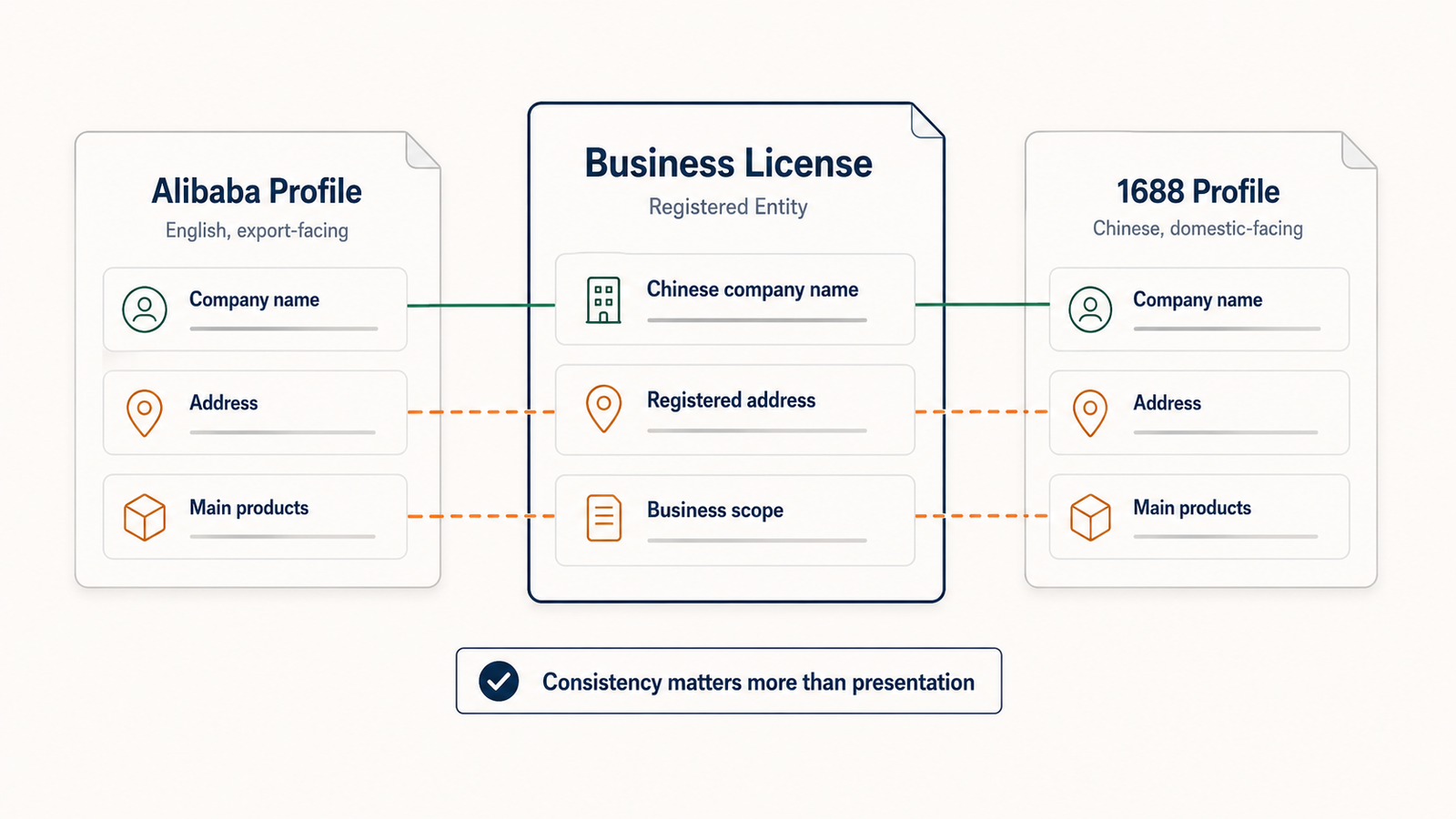
In the supplier-verification record reviewed for ChinaSourceLab — 3,123 Reddit comments across r/Alibaba and r/importexport, 2018–2026 — “1688” appears 106 times, and not mainly as a place to buy. It appears as a way to check what an Alibaba supplier claims. For a buyer about to pay a deposit, that is what 1688 is most useful for: a second place the same supplier has already described itself. Alibaba is the supplier’s outward-facing profile, written for overseas buyers in English. 1688 is the domestic-facing profile, written in Chinese for Chinese wholesale buyers. When the same company appears on both, the two profiles can be compared — and the gaps between them are where identity claims fail.
In those threads, 1688 is not framed as a sourcing channel. It is framed as a check. A Shenzhen-based sourcing professional, posting on r/Alibaba in a thread comparing 1688 and Alibaba for small importers, described using 1688 to cross-reference what an Alibaba supplier claimed against what the same company showed domestically — the post drew 53 upvotes and 52 comments, high engagement for a sourcing-mechanics thread.
This article stays inside that use. It does not cover how to buy on 1688, how to compare 1688 and Alibaba prices for sourcing, or how to find an agent. It covers one thing: how to use 1688 to check whether an Alibaba supplier’s stated identity holds up before money moves.
Why 1688 Is a Verification Tool, Not a Sourcing Shortcut
1688 is Alibaba Group’s domestic wholesale platform. The same factories and trading companies that list on Alibaba.com for export often maintain a 1688 storefront for the Chinese market. The two storefronts are written for different audiences, by different teams inside the same company, with different incentives.
That difference is what makes 1688 useful as a check. The Alibaba profile is a sales document aimed at a buyer who cannot read Chinese, cannot easily verify claims, and is comparing suppliers on English-language presentation. The 1688 profile is aimed at domestic buyers who can read the company’s registration details, recognize a trading company from its product range, and price a product against the rest of the market. A company that overstates its capabilities to overseas buyers may describe itself differently on the domestic side, especially in its product range, business model, and company profile language.
1688 is not a more honest platform. It is another presentation layer. The point is not to trust what 1688 says — it is to compare what 1688 says against what Alibaba says, against the business license, and against the Proforma Invoice. Consistency does not prove safety. Inconsistency creates a file to resolve before payment.
Find the Supplier’s 1688 Entity Using the Chinese Company Name
The search starts with the Chinese company name, not the English one. The English transliteration a supplier uses on Alibaba — “Shenzhen Tbay Technology Co., Ltd.” — usually returns nothing on 1688, because the platform indexes companies by their registered Chinese name. The Chinese name comes from the business license, which is why reading the license matters before this step. The method is covered in How to Read a Chinese Business License Without Knowing Chinese.
With the Chinese company name, search 1688 directly. One of three things happens. The company has a 1688 storefront under the same registered name, which gives a second profile to compare. The company has no 1688 presence at all, which is common for suppliers built purely for export and is not a problem by itself. Or the Chinese name resolves to a different company than the one on the Alibaba profile — which is the result worth stopping for, because it means the entity behind the export profile is not the entity the name implied.
A supplier that cannot be found on 1688 is not automatically a risk. A supplier whose 1688 entity contradicts its Alibaba entity is. Where the names resolve to different companies, the registered identity itself needs checking against the official company registry using the Chinese company registration number.
Cross-Check Company Name, Address, and Main Products Across Both Platforms
When a 1688 storefront exists, three fields carry most of the verification value. Each is compared against the Alibaba profile and the business license.
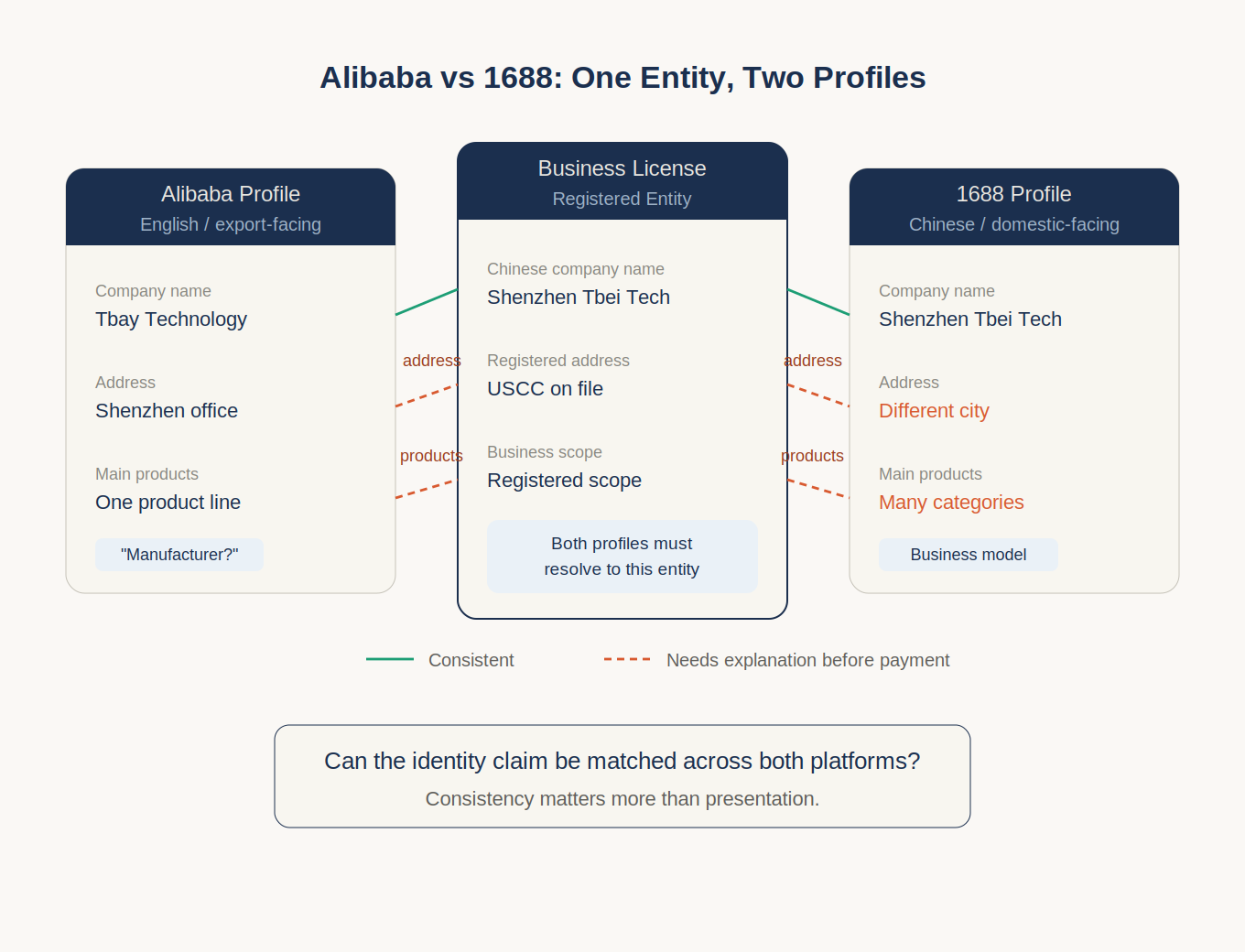
The registered company name should be identical across all three sources. Not similar — identical, allowing for transliteration. This is the registered name in the storefront’s company information section, not the shop’s display title, which is often a brand name or abbreviation. A 1688 entity registered to a different company name than the Alibaba profile means the two storefronts belong to different legal entities, regardless of how the supplier explains the relationship.
The address should be explainable. A registered address, an office address, and a factory address may all differ — that is normal. What the supplier should be able to do is say which address is the registered one, which handles sales, and which produces or ships the goods. A factory that cannot account for the relationship between its 1688 details, its business license address, and where the goods actually come from has left a gap worth closing before payment.
The main product categories should be consistent with the Alibaba claim. In the supplier’s 1688 shop profile or company information section, the registered business model, main products, and company description describe what the company actually sells domestically. A supplier presenting itself on Alibaba as a specialized manufacturer of one product line should not appear on 1688 as a general distributor spanning unrelated categories.
A Supplier Verification Checklist covers these cross-checks alongside the business license and payment-account checks, which is where they belong — 1688 is one source in a wider document comparison, not a standalone test.
Identify When a “Manufacturer” Claim Does Not Match the 1688 Product Range
The most useful thing 1688 reveals is the gap between a “manufacturer” claim and a domestic product range that says otherwise. This is the same distinction covered in Factory or Trading Company? — 1688 is one of the clearest places to test it.
A genuine manufacturer’s 1688 profile tends to concentrate on one product family and describe production directly: the registered business model, the company description, and the product range point to a factory that makes a specific category of goods. The shop description references production lines, equipment, processing capability, or quality control.
A trading company’s 1688 profile reads differently. The product range spans multiple unrelated categories. The company description leans on sales language — broad sourcing, drop-shipping support, sample customization — rather than production capability. A supplier that claims “factory direct” on Alibaba while its 1688 entity sells across unrelated categories with no production language is describing two different businesses to two different audiences.
The platform’s own labels are platform-side signals, not proof — and they are not equal. Chengxintong (诚信通) is a paid annual membership; it confirms the supplier pays for a 1688 storefront, nothing more about its capabilities. Verified-strength merchant and super factory are supply-side capability tiers that carry more weight but still rest on 1688’s own criteria. None of them confirms the company’s registration, its payment account, or that it will ship what it promised. A label is a starting point for a question, not an answer.
Read Price Gaps as Signals, Not Proof
A 1688 price is usually lower than the same supplier’s Alibaba quote. This difference is normal and expected. The Alibaba quote can include the cost of export handling, English-language support, smaller minimum order quantities, export packaging, international payment terms, and the platform’s own margin. A higher Alibaba price is not evidence of anything by itself.
The price gap is a comparison point, not a verdict. What is worth stopping for is a price that contradicts the supplier’s stated identity.
A supplier claiming factory-direct pricing on Alibaba whose quote sits far above the 1688 price for the identical product should be asked to explain what the export quote includes. A supplier whose Alibaba quote falls below the 1688 market range for that product — unusually, against the normal direction of the gap — while pushing for fast payment is showing a pattern that recurs in dispute threads. And a supplier who cannot explain where a price comes from, in either direction, has left a question unanswered.
One r/Alibaba thread on what buyers should know before ordering — 39 upvotes — made the domestic-pricing point bluntly: for low-volume buyers, much of the Alibaba price is the cost of not seeing the domestic market directly. That is a fair description of the information gap. It is not a basis for treating every higher Alibaba quote as fraud. The price gap tells you where to look, not what you will find.
Before You Pay: A 1688 Cross-Check Sequence
This sequence runs against an Alibaba supplier before a deposit moves. It assumes the business license is already in hand, since the Chinese company name drives the search.
Step 1. Take the registered Chinese company name from the business license — not the English name from the Alibaba profile.
Step 2. Search that name on 1688. Full company information often requires a logged-in account, and access from outside China can be limited — a sourcing contact inside China, or a verification service, can retrieve what an overseas search cannot. Note which of the three outcomes applies: matching entity, no presence, or a different entity.
Step 3. If a storefront exists, compare the registered company name across 1688, Alibaba, and the business license. All three should resolve to one entity.
Step 4. Compare the registered address across the same three sources.
Step 5. Compare the 1688 main product range and business model against the Alibaba “manufacturer” or “trading company” claim.
Step 6. Compare the 1688 price range against the Alibaba quote — and read the gap as a signal to investigate, not as a conclusion.
Step 7. Treat platform labels as starting points, not safety proof.
Step 8. Resolve any contradiction between the two platforms in writing before paying. A 1688 cross-check is not a substitute for official registration verification — it sits alongside the business license and payment-account checks inside a wider pre-payment supplier review.
The value of the 1688 check is not that it confirms a supplier is safe. No single source does that. Its value is narrower and more useful: it gives the buyer a second profile, written by the same company for a different audience, and a chance to find the contradiction before the money does.